
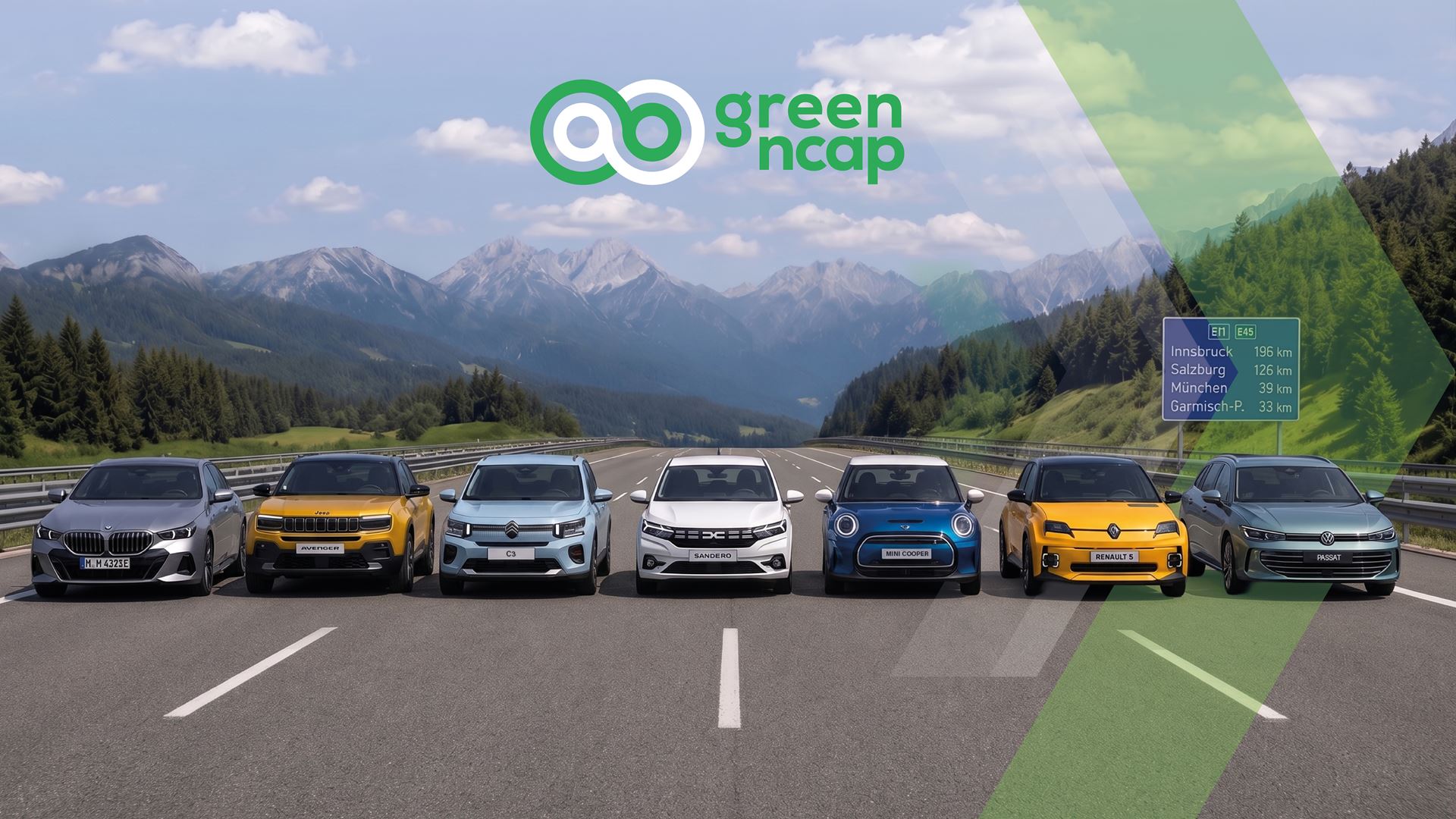
LEUVEN, BELGIUM – More of Europe’s drivers are switching to the latest generation of electric cars, believing they are doing the right thing for the environment. But are they?
Green NCAP, which provides consumers with an impartial overview of a new car’s environmental impact and real-world driving performance, is shining a light on the sustainability of some of the continent’s most popular new models.
While manufacturers typically publish data regarding energy consumption, range, and charging times – often labelling EVs as "zero-emission" – these figures rarely tell the full story.
Manufacturing, battery production, distribution, and energy sourcing can all bring a significant carbon impact that standard ratings often ignore. Using its industry-leading "cradle-to-grave" life cycle assessment methodology, and by publishing invaluable information about hot topics including driving range, charging times and even the effectiveness of cabin insulation, Green NCAP provides trusted and impartial information that shows consumers a car’s true environmental impact over its lifetime.
The differences between cars can be significant – to both the planet and a driver’s wallet. Generally, the more efficient the car, the less energy it consumes over time. In addition, the energy and resources required during production significantly influence the car’s impact.
Here, Green NCAP assesses some of the best-selling models in Germany, France, Italy, and Spain, as well as the UK. Because these models are sold in such high volumes, their collective environmental footprint is substantial.
These examples represent just a small selection of almost 200 models that are tested and rated with an easy-to-follow sustainability rating, that consumers can browse at www.greenncap.com.
Life cycle assessment: the complete picture of a car’s carbon footprint
Advertising electric cars as "zero emission" without context can be misleading. Simply using a battery to power a motor does not automatically make a vehicle sustainable.
To help consumers see beyond showroom marketing, Green NCAP provides independent, evidence-based ratings. By using LCA, Green NCAP reveals the environmental burden from production to disposal. This includes scoring raw materials, manufacturing, distribution and energy supply, alongside direct greenhouse gas emissions – providing the only truly reliable measure of environmental performance available to European drivers.
Analysing Europe’s most popular cars
- Dacia Sandero - Sustainability Rating: 3 stars (59%)
One of Europe’s most popular new cars, the Sandero ranked at seventh overall in the sales charts, for the first quarter of the year, and in 2025, it was Spain’s most popular car and Italy’s runner-up. Drivers are drawn to the compact hatchback because it’s good value for money – but is it also good for the environment?
Green NCAP tested the petrol-powered TCe 100 petrol-powered version and found it delivered respectable real-world efficiency. The Sandero performed reasonably well for emissions from the tailpipe and abrasion (tyres and brakes), and its energy efficiency was above average. However, its greenhouse gas performance fell short of hybrid or electric alternatives. Green NCAP highlighted the benefit of the car’s relatively low mass and straightforward engineering approach. The Sandero demonstrates that affordable conventional cars can achieve respectable environmental performance.
- Citroën C3 Hybrid - Sustainability Rating: 3 ½ stars (62%)
The Citroën C3 is a competitor to the Dacia Sandero, and nearly as popular, being the ninth best-selling car in Europe in the first quarter of 2026. Green NCAP tested the 110 Hybrid and found that its mild hybrid system brought some gains in efficiency and reduced fuel consumption, especially in urban driving. Overall, the C3 was shown to have low energy consumption throughout its life cycle assessment. While retaining mainstream affordability and practicality, the Hybrid C3 only offers a slight environmental advantage over conventional petrol-powered small hatchbacks.
- Volkswagen Passat - Sustainability Rating: 3 stars (52%)
Germany is Europe’s largest market for new car sales (2.8 million a year), and a long-standing favourite is the Volkswagen Passat – the seventh most popular last year. The large family car can be traced back to 1973, although the latest version has come a long way since then. Green NCAP tested the 1.5 eTSI model, which combines mild hybrid assistance with petrol power.
While the Passat achieves a respectable three-star rating, its performance varies across the three assessment pillars. It scored reasonably well in the Clean Air index (6.8/10) thanks to effective exhaust after-treatment, but its Greenhouse Gas index (3.4/10) was limited by the inherent CO2 emissions of its petrol engine. The car proved most efficient during highway driving. Overall, it remains a solid choice for long-distance family travel, and its performance is more than respectable when allowing for the Passat’s size and weight.
- Renault 5 E-Tech - Sustainability Rating: 5 stars (94%)
The Renault 5 was France’s best-selling electric car in April, and based on Green NCAP’s findings, its success is down to more than the return of a much-loved name. Green NCAP’s expert testers praised the electric hatchback for combining very low operating emissions with efficient energy consumption. The assessment highlighted strong scores across Clean Air (9.1/10) and Energy Efficiency (9.3/10) categories, and a perfect 10 in Greenhouse Gas levels. Green NCAP’s data suggested Renault’s compact platform and low mass (1453 kg) contribute to excellent efficiency, even during the manufacturing phase. The Renault 5 E-Tech demonstrates how smaller electric cars can maximise environmental performance while remaining practical and accessible for mainstream buyers.
- MINI Cooper E - Sustainability Rating: 5 stars (95%)
Perennially popular with drivers, especially in the UK, the latest electric version of the MINI Cooper is one of the least impactful cars assessed by Green NCAP. The electric model achieved a remarkably high score, standing out as a leader in sustainability due to its efficient powertrain and compact design. By balancing low vehicle mass (1,561kg) with a modest 36.6 kWh usable battery capacity, the Cooper E minimises energy demand across all tested conditions, as well as during manufacturing. It scored a strong Energy Efficiency Index of 9.7/10, and a 9.4/10 for Clean Air and 9.6/10 for Greenhouse Gases, with life cycle emissions calculated at a very low 117 g CO2-eq./km. Green NCAP also highlighted the MINI’s effective recuperation braking, which significantly reduces brake wear and non-exhaust emissions. Overall, it represents a benchmark for urban mobility, proving that "smaller is better" for drivers wanting to minimise their environmental footprint.
- Jeep Avenger Electric - Sustainability Rating: 5 stars (96%)
The Jeep Avenger Electric has the rugged-look appeal that so many drivers like, yet it is an SUV that treads more lightly than others – no doubt explaining its popularity in Italy and Spain. Built on the Stellantis eCMP2 platform, the electric crossover shares its foundation with the FIAT 600e and is rated by Green NCAP using a methodology that allows the transfer of test results to vehicles with the same key technical specifications. So, like its sibling, it achieves an expected five stars and an overall score of 96 percent and a perfect Greenhouse Gas Index (10/10). In real-world mild weather, its estimated consumption is 16.4 kWh/100 km. However, efficiency could potentially drop in the -7°C cold ambient test, with consumption rising to 24.8 kWh/100 km, which might limit its winter test range on mixed roads.
- BMW 5 Series - Sustainability Rating: 2.5 stars (46%)
A top 10 seller in Germany last year, in many respects the BMW 5 Series is a benchmark for buyers wanting an executive saloon or estate car. But its environmental performance reflects the challenges of a heavy, combustion-powered car.
Tested in its 520i mild-hybrid petrol form, the 1,805-kg saloon achieved a 2.5-star rating. While it earned a respectable 6.5/10 for Clean Air due to highly effective exhaust after-treatment, its Greenhouse Gas rating (2.7/10) was hampered by high fossil fuel consumption. Real-world tests showed efficiency is adequate for its class, but the 5 Series lacks the energy recuperation needed to compete with more electrified rivals on sustainability.
By using Green NCAP's independent sustainability ratings, Europe’s motorists can now identify which of the continent's best-selling cars have the lowest environmental impact from cradle to grave.
Unlike standard ratings that focus primarily on tailpipe emissions, Green NCAP’s sustainability rating is the most authoritative, impartial overview of a car's total environmental impact. Factors such as battery size, vehicle weight, and the sustainability of energy supply processes shape a car’s overall footprint.
And with a wealth of information about real-world driving experience, Green NCAP is also the go-to resource to determine how well a new car meets a driver’s practical needs.Dr. Aleksandar Damyanov, Technical Manager Green NCAP