
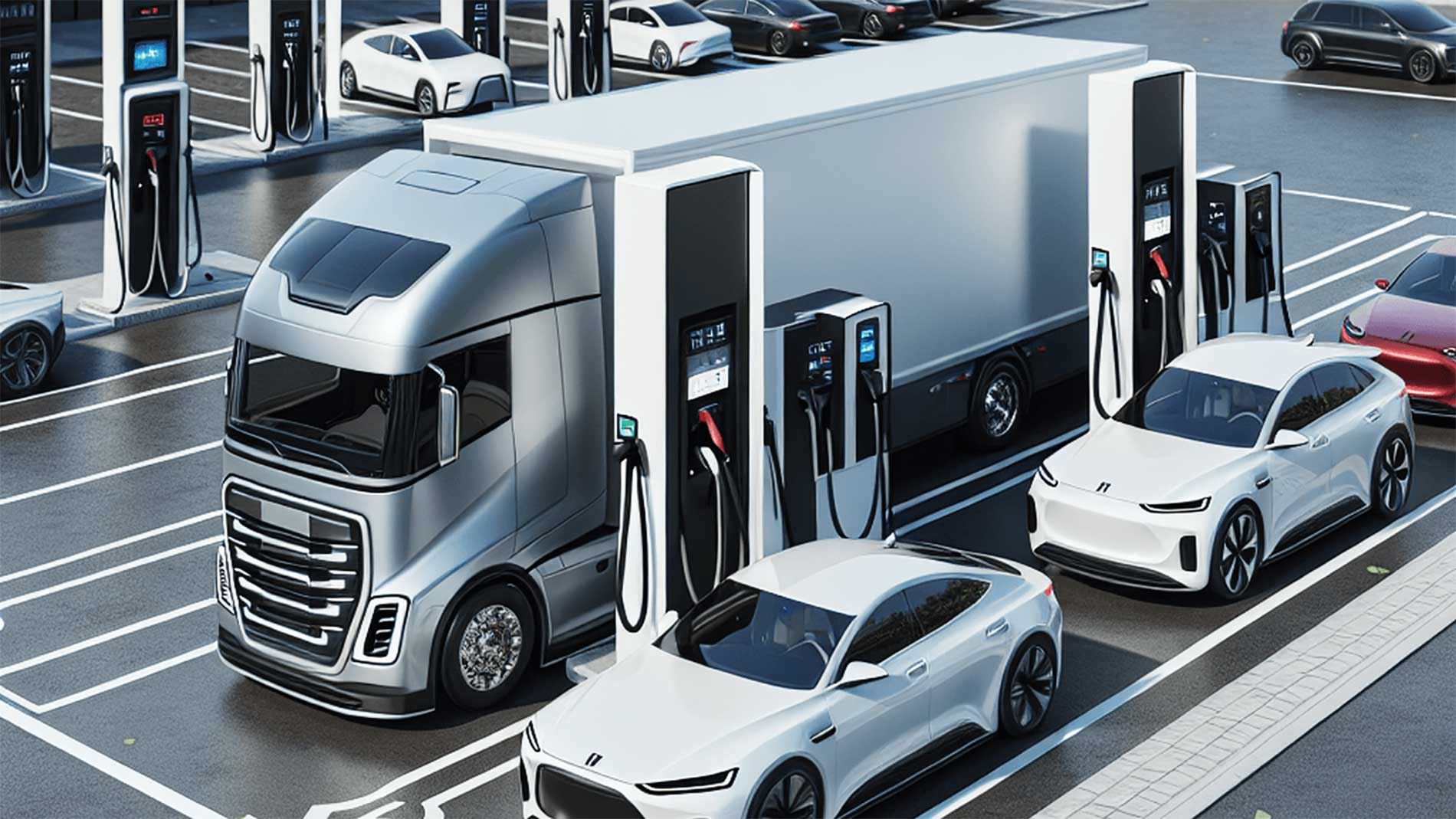
Interview with Andreas Hensel, Fraunhofer Institute for Solar Energy Systems ISE, on BYD’s megawatt charging, the limits of today’s fast-charging infrastructure and resilient charging parks.
BYD reports charging capacities in the megawatt range for passenger cars. Is this a technological turning point or primarily an industrial-policy signal?
It is impressive what is being shown there technologically. It shows that such charging capacities are technically possible in principle. But I would also classify it above all as a signal and as a marketing instrument. For the mobility transition at scale, such charging capacity is not necessary in my view.
Why not? If an electric car could charge in five to ten minutes, that would surely be a strong argument for switching.
Of course, a short charging time is attractive. But one has to ask where the actual bottleneck lies. In the passenger-car sector, I do not see it primarily in maximum charging capacity. In the CCS area, up to 500 amps are possible today, which means around 400 kilowatts for 800-volt vehicles. Many vehicles currently on the market do not reach this capacity at all, or only for a short time. The greater bottleneck lies in the grid connection and in economic viability.
So battery, power electronics, cables and cooling would be technically manageable?
Yes, these technical issues can in principle be brought under control with today’s solutions. But that costs money, both on the vehicle side and on the infrastructure side. The higher the charging capacity, the more complex the components become. The decisive question is therefore not only what is physically possible, but whether it makes sense and is affordable for the specific use case.
Where do the biggest problems lie with the grid connection?
The time constants in grid expansion are very long. Grid operators have to plan over many years. I recently had a conversation with Netze BW. There, the assumption is that grid capacities in the distribution grid will have to roughly double within the next ten years. That is an enormous challenge.
China is faster in industrialisation and rollout, Europe strong in research and standards. Does this comparison hold?
It is not entirely wrong, but of course it is strongly simplified. For domestic industry, it will be challenging to keep up permanently because in many areas we are more sluggish and have different starting conditions. We have an existing grid, dense development and many regulatory processes. At the same time, there are many technologically innovative manufacturers and research institutions in Europe.
Continue reading on Gateway to Automotive.