
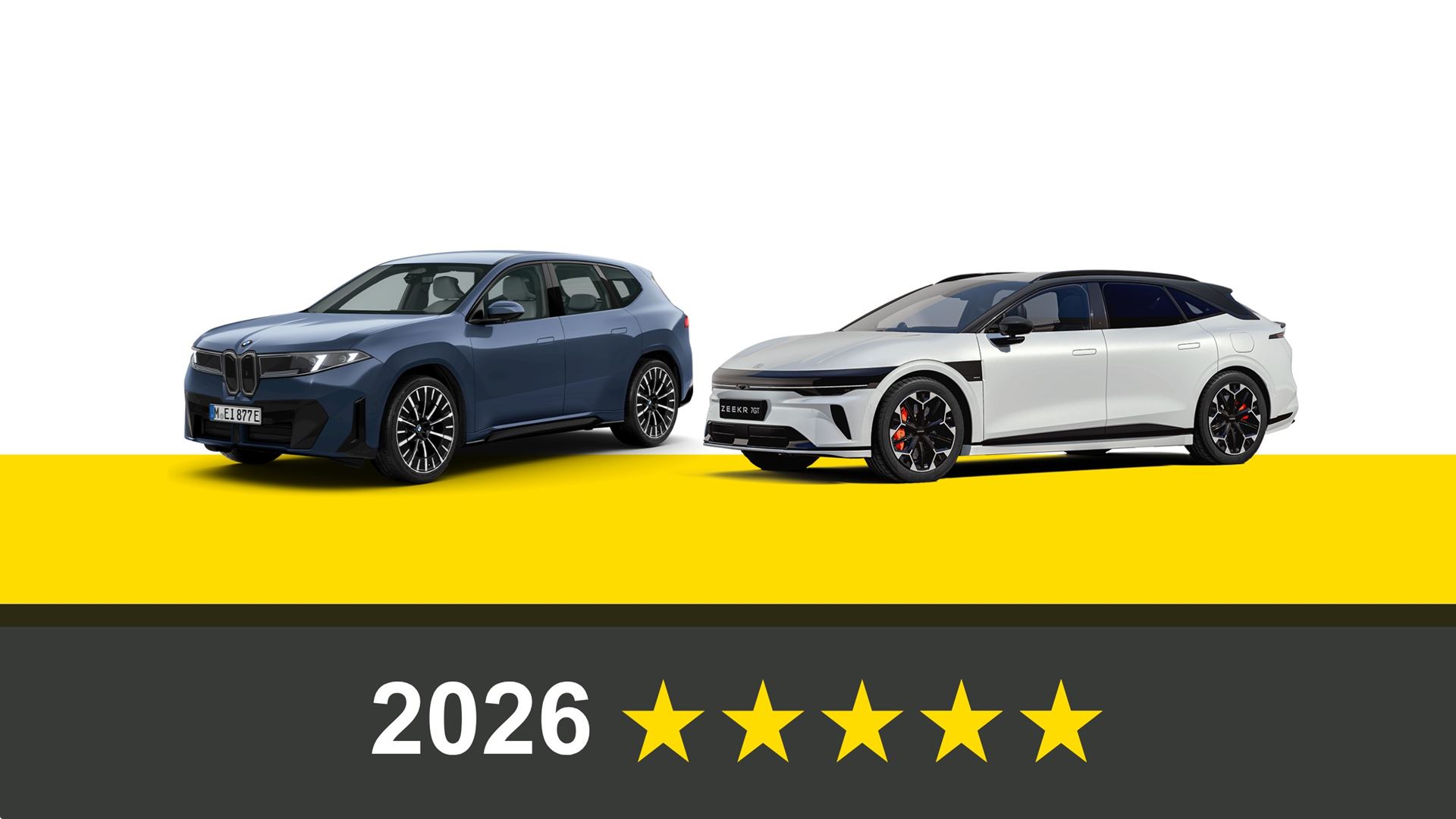
- First vehicles evaluated using Euro NCAP's most significant overhaul of its testing and scoring procedures in over a decade.
- The Stages of Safety are the most complete evaluation of modern cars’ safety and focus on the entire safety journey ─ from safe driving to post-crash response.
- The ‘Neue Klasse’ BMW iX3 and ZEEKR 7GT both achieve a five-star score.
- Shows that both European and Chinese manufacturers have adapted successfully to the more challenging assessment protocols.
LEUVEN, BELGIUM – Euro NCAP has introduced its advanced 2026 vehicle safety assessment protocols, representing the most comprehensive overhaul of its testing and rating system in years. The new framework raises the standard for consumer protection, placing greater emphasis on intuitive and effective driver assistance systems, robust crash avoidance, occupant protection for a diverse population, and post-crash safety and care. The results show that manufacturers are already rising to the challenge. Both the all-new BMW iX3 and the ZEEKR 7GT have earned Euro NCAP's highest five-star safety rating under the new protocols.
When Euro NCAP was founded in 1996, many car makers openly resisted independent crash testing, asserting that it would be neither practical nor financially viable to meet such safety expectations. However, over time, manufacturers grew to recognise Euro NCAP’s five-star rating, transforming vehicle crashworthiness into an imperative, core consumer value.
Today, a similar technological and regulatory turning point has arrived. As modern vehicles become increasingly reliant on complex driver assistance systems, software integration, digital touch interfaces, and high-voltage electrified platforms, Euro NCAP has laid down a set of new challenges for car makers. New protocols shift the focus toward the Stages of Safety – the most complete method yet of evaluating the many ways a modern car can protect occupants and other road users.
In summary: the four Stages of Safety
- Safe Driving – How well does the vehicle support the driver and passengers and provide a safer driving experience?
- Crash Avoidance – How effectively can the vehicle identify hazards and help prevent or mitigate a crash?
- Crash Protection – How well do the vehicle's structure, airbags and restraints protect occupants and other road users?
- Post Crash – Can the vehicle’s design and on-board systems assist emergency responders to improve occupant treatment following a crash?
BMW iX3: 5 stars
The 'Neue Klasse' BMW iX3 50 xDrive (large electric SUV, 2,285 kg kerb weight) delivered an outstanding performance across all stages of the assessment and may be BMW's safest car to date.
In the Safe Driving (73 per cent) assessment category, the iX3 was praised for its dedicated physical controls for the indicators, hazard lights, horn, headlights, and gear selectors. Its driver monitoring proved effective at detecting physiological driver fatigue and impairment, though it demonstrated lower sensitivity toward short-term visual distraction. During a 2,000-km real-world road trial across Italy, France, Germany, and Austria, its speed limit assist function identified signage changes correctly in 86 per cent of instances, covering 97 per cent of the driven distance. The iX3 offers advanced cabin monitoring that can classify occupants but does not include more innovative features such as detection of out-of-position of front passenger or improper seatbelt use.
The new iX3’s Crash Avoidance (83 per cent) technologies performed exceptionally well with autonomous emergency braking (AEB) comfortably exceeding new Euro NCAP requirements, showing good mitigation capabilities across vehicle-to-vehicle, junction-turning, and motorcycle collision paths. Pedestrian and cyclist protection was excellent, while its lane departure avoidance systems also performed well.
In Crash Protection (86 per cent), the iX3 secured maximum points in all side-impact evaluations, aided by its standard centre airbag which prevents impacts between occupants. Frontal offset testing demonstrated good or adequate protection for all adult statures, including the small adult female dummy in the front passenger seat. The iX3 did not receive full marks in the full width test due to a marginal driver chest score of 85% despite maximum points being awarded for both rear child dummies.
The vehicle scored an outstanding 95% in Post Crash safety. Its built-in eCall setup reliably coordinates with first responders. The electric high-voltage architecture executed flawless battery isolation – essential to help minimize the risk of fire – while all electrically actuated door handles extended and remained fully operable post-impact, complemented by an accessible manual override release.
ZEEKR 7GT: 5 stars
The ZEEKR 7GT Privilege AWD (large electric family car, 2405 kg kerb weight) showcased high-performing software intelligence and excellent overall structural crashworthiness.
For Safe Driving (79 per cent), the 7GT features a sophisticated driver monitoring layout that scored maximum marks for addressing instances of acute visual distraction as well as fatigue and drowsiness. It includes advanced sensors that flag incorrect lap-only seatbelt use and a manual front passenger airbag cut-off switch for rear-facing child restraints, in addition to standard child presence detection to alert external bystanders in case of child is left behind.
Many of the ZEEKR 7GT’s features and functions – from driving settings to climate control – are operated a central touchscreen rather than physical switches and buttons, which resulted in a poor score for general vehicle controls. In 2,000 km of driving on roads through Spain and France, its speed assist correctly identified limit signs in 79 per cent of cases, representing 89 per cent of total distance covered.
In Crash Avoidance, the 7GT earned a standout 89 per cent. Its active safety assist systems responded and performed well. The AEB demonstrated near-flawless execution in a range of common high-risk scenarios, mitigating frontal, reversing, and intersection crossing risks. Its integrated 'dooring' prevention system successfully warned occupants against opening doors into approaching cyclists.
Its Crash Protection (93 per cent) was robust. The 7GT scored maximum points across side mobile barrier, side pole, and far-side occupant impacts, in part thanks to its centre airbag configuration. Frontal offset testing yielded good or adequate adult protection and perfect scores for rear child dummies. Virtual modelling and sled testing across the 5th, 50th, and 95th percentiles proved structural versatility.
In Post Crash safety, the 7GT matched the iX3 with a score of 95 per cent, executing automatic high-voltage power isolation, automatic door unlocking, and excellent impact energy management. Its manual door handles remained undamaged and could be opened in all tests. Points were only dropped because its TPS eCall functionality did not achieve a maximum score.
The new Euro NCAP protocols were introduced as much in response to consumer feedback as they were in response to evolving engineering capabilities and innovation around technology.
The five-star scores of the BMW iX3 and ZEEKR 7GT show that car makers can produce models that are safe on many levels, from the simple but important inclusion of physical switches and buttons to the way driver aids feel in-tune with the driver rather than at-odds with them.
The new Euro NCAP protocols were introduced as much in response to consumer feedback as they were in response to evolving engineering capabilities and innovation around technology.
The five-star scores of the BMW iX3 and ZEEKR 7GT show that car makers can produce models that are safe on many levels, from the simple but important inclusion of physical switches and buttons to the way driver aids feel in-tune with the driver rather than at-odds with them.
Automotive safety has evolved a great deal since Euro NCAP published its first test results in early 1997, and our organisation is proud to have played a part in striving for safer vehicles and roads. We believe Euro NCAP’s latest testing protocols will play a key role in that journey toward safer cars.Dr. Aled Williams, Programme Director Euro NCAP
| Tested Vehicle (2026) | Safe Driving | Crash Avoidance | Crash Avoidance | Post Crash Safety | Overall Rating |
| BMW iX3 50 xDrive | 73% | 83% | 86% | 95% | ★★★★★ |
| ZEEKR 7GT Privilege AWD | 79% | 89% | 93% | 95% | ★★★★★ |