
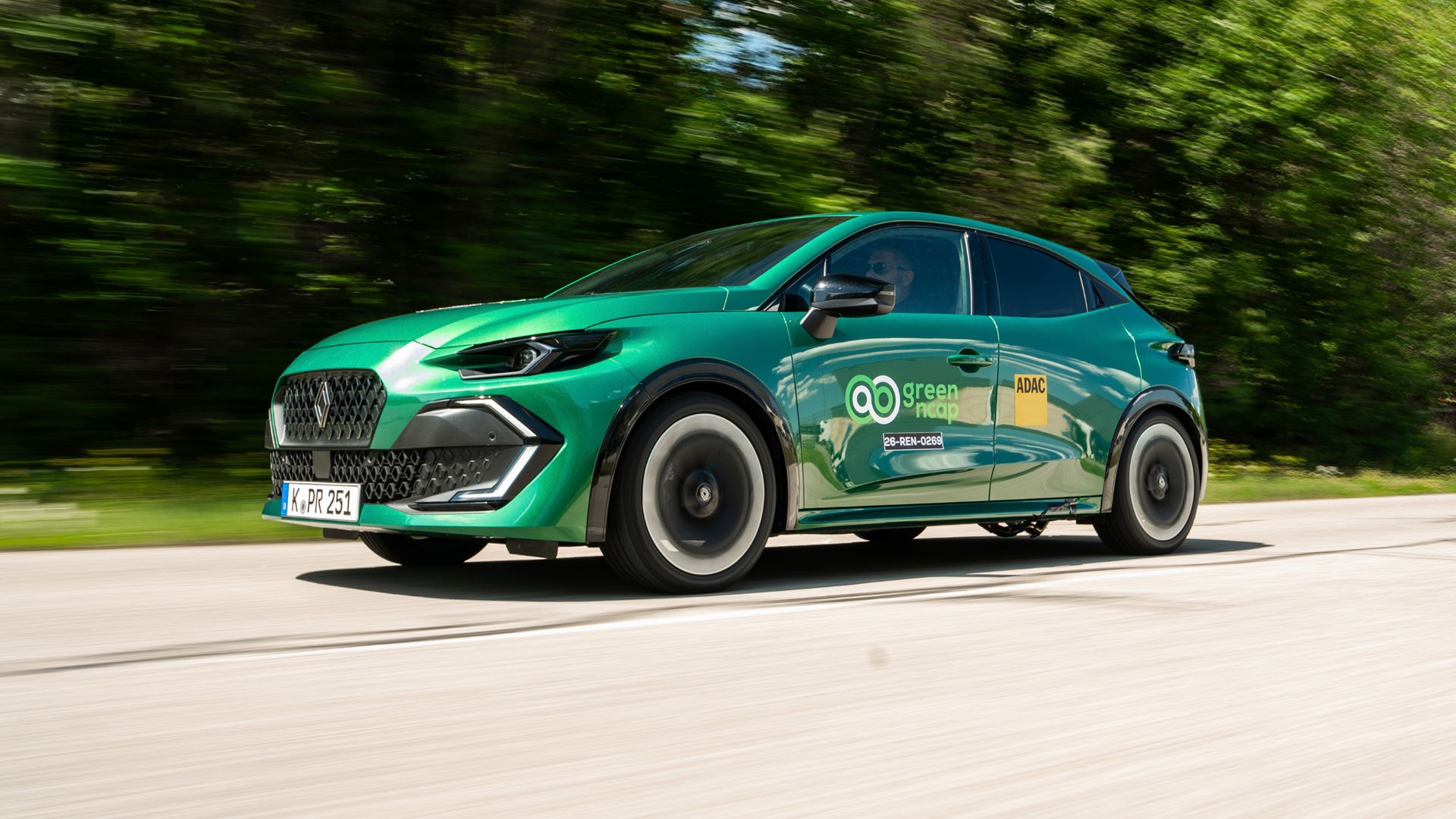
- Green NCAP awards the Renault Clio a three-and-a-half star Sustainability Rating
- Petrol-powered model is Europe’s second most-popular new car and achieves a 62% overall score, showing that consumers who choose a non-EV alternative can also contribute to reducing environmental impact
- Compared with other combustion-only superminis, the Clio scores well for Clean Air, Energy Efficiency and Greenhouse Gases
- Good Sustainability Ratings for the electric Kia EV4 crossover (five stars) and MAZDA 6e saloon (four-and-a-half stars)
- EVs, hybrid, petrol- and diesel-powered cars undergo assessment, including the Kia K4, MG’s MG3, Renault Symbioz and VW Tiguan
LEUVEN, BELGIUM – Intelligent engineering has helped one of Europe’s most popular new cars prove that affordable petrol-powered models still have a place on our roads. Environmental testing performed by Green NCAP shows the Renault Clio, the second best-selling car of 2025, achieves a three-and-a-half star Sustainability Rating, with a score of 62%.
Significantly, the assessed 2026 Clio TCe 115 Techno did not rely on any form of hybrid or electric propulsion to achieve its rating. This places the Clio among the best performers in its class and is good news for environmentally conscious consumers who may prefer an affordable, conventionally powered car.
Of the latest electric cars to go under Green NCAP’s spotlight – which examines the whole-life environmental impact of a car and rates its real-world usability – the Kia EV4 performed best, with a five-star rating, closely followed by the four-and-a-half star MAZDA 6e. A further mix of hybrid, petrol- and diesel-powered cars were also assessed for their environmental impact, including the Kia K4, MG MG3, Renault Symbioz, and VW Tiguan.
- Renault Clio TCe 115 Techno Petrol
Sustainability Rating: 3 ½ stars / 62%
Many of Europe’s drivers have found that the push toward electric cars has come at a cost: there are fewer affordable cars with conventional combustion engines in showrooms. The Renault Clio still offers that choice – and shows that the impact of fossil-burning vehicles can be lessened.
In both laboratory and on-road environments, tests carried out by experts from Green NCAP reveal that the Renault Clio’s three-cylinder, turbocharged petrol engine with direct fuel-injection strikes a good balance between delivering nippy performance and driving enjoyment, and frugal consumption with low exhaust emissions. Its performance is helped by the car’s kerb weight – a relatively low 1,186kg.
It scored 6.8/10 for Clean Air, 7.1/10 for Energy Efficiency and 4.9/10 for Greenhouse Gases. These mark it out as one of the most sustainable petrol-powered superminis available, together with the SEAT Ibiza and Volkswagen Polo.
- Kia EV4 Earth Electric (81.4 kWh)
Sustainability Rating: 5 stars / 90%
An electric crossover, the Kia EV4 scored an impressive 90% overall. The process of reducing its environmental burden begins with production; built in Slovakia, Kia’s manufacturing is calculated with assumptions made for European production, limiting lifecycle climate impact to 119 g CO2-eq./km.
The aerodynamic design aids energy efficiency, and the EV4’s real-world driving range holds up in cold conditions. The EV4 features manual and automatic battery pre-conditioning activation to optimise charging; DC fast charging starts at up to 130 kW before tapering off to protect battery health towards the end of the charging. Additionally, it offers advanced bidirectional charging possibilities.
- MAZDA 6e 258 Takumi Electric
Sustainability Rating: 4 ½ stars / 85%
Built under the Changan MAZDA joint venture on Changan’s EPA1 platform in China, the electric MAZDA 6e saloon achieved an 85% overall score, held back by the impact of manufacturing and distribution. Despite this, the 6e’s aerodynamic body shape and highly efficient powertrain help offset production emissions. It delivered consistent energy consumption across all temperatures, solid real-world driving range, and excellent cabin heating in cold conditions compared to its EV peers.
- Renault Symbioz E-Tech Full Hybrid 160
Sustainability Rating: 3 ½ stars / 64%
Positioned as a compact SUV with hybrid power, the Renault Symbioz recorded a 64% overall score. The vehicle demonstrates how full hybridisation can lower environmental impact in mid-sized family cars, achieving a low 4.2/100km fuel consumption in warm weather lab test. European production further benefits its LCA profile.
However, its hybrid efficiency advantages diminish in the winter cold start test (7.4l/100km cold start at -7°C) and during faster highway driving (6.8l/100km). In freezing conditions, the engine must run frequently to provide cabin heat due to the absence of a high-voltage heater. Consequently, cabin-heating performance was rated poor, taking up to 20 minutes to warm footwell and rear cabin areas to 16°C.
- MG MG3 1.5 Petrol
Sustainability Rating: 3 stars / 51%
Like the Renault Clio, this 1.5-litre petrol version of the MG3 supermini does without any form of hybrid propulsion, but can’t match the Clio, with a Sustainability Rating of 51%. Its low kerb weight (1,162 kg) helped limit production energy demand and secured points for low tyre wear. The inclusion of rear drum brakes also aided non-exhaust emissions by containing brake dust. However, fuel consumption was unimpressive for a car of its size (5.8l/100km during a real-world mixed drive), while elevated particle and carbon monoxide emissions during cold starts restricted its Clean Air performance.
- VW Tiguan 2.0 TDI Elegance
Sustainability Rating: 2 ½ stars / 48%
Powered by a conventional 2.0-litre diesel engine without hybrid assistance, the VW Tiguan achieved a 48% Sustainability Rating. Green NCAP’s testers found the SUV effectively controls tailpipe pollutants across all test regimes and scored 8.7/10 for exhaust emissions. Its diesel consumption values are fairly competitive for a vehicle of its type. However, the simple fact is that burning fossil fuels drives total lifecycle emissions to 246g CO2-eq./km, harming its Greenhouse Gas score.
- Kia K4 1.6 T-GDI Spirit
Sustainability Rating: 2 ½ stars / 46%
The non-hybridised petrol Kia K4 registered a 46% overall score. Being produced outside Europe and relying entirely on fossil fuel combustion pushes its lifecycle emissions to 257g CO2-eq./km, with 160g coming directly from tailpipe emissions. Despite its unexceptional fuel consumption (real world test recording 5.8l/100km mixed and 6.3l/100km urban), like the Tiguan, the K4 achieved a respectable exhaust emissions score of 8.7/10 due to robust control of pollutants output.
The Renault Clio TCe 115 Techno demonstrates that good engineering still has an important role to play in reducing the environmental impact of conventional cars. Its relatively low weight, efficient petrol engine and effective emissions control help it achieve a strong result without relying on hybridisation. While our latest assessments underline the sustainability advantages that well-designed electric vehicles can offer, the Renault Clio TCe 115 Techno shows that manufacturers can also make meaningful improvements to affordable combustion-engine cars that remain an important part of today’s market.Dr. Aleksandar Damyanov, Technical Manager Green NCAP