From greater roadrunners and Gambel’s quail to black-throated sparrows and vermillion flycatchers, New Mexico is home to a wide variety of beautiful birds. New Mexico State University’s Avian Migration Program prepares undergraduate and graduate students to become leaders in avian conservation and resource management, helping protect these birds and the environments we all call home.
The program is funded by a grant from the US Department of Agriculture’s National Institute of Food and Agriculture, with additional support from NMSU’s College of Arts and Sciences, College of Agricultural, Consumer and Environmental Sciences, Division of Student Success, Office of the Vice President for Research and Graduate School.
Enabled by these sponsors, the Avian Migration Program provides hands-on learning experiences and specialized development opportunities. Students gain access to research experience, conferences, career fairs, seminar speakers, professional development workshops, outreach events and more. Most importantly, students complete the program having grown their communication, research and leadership skills. Many go on to postdoctoral positions and graduate programs, or to jobs with federal agencies, national labs, field research programs and conservation-oriented organizations.
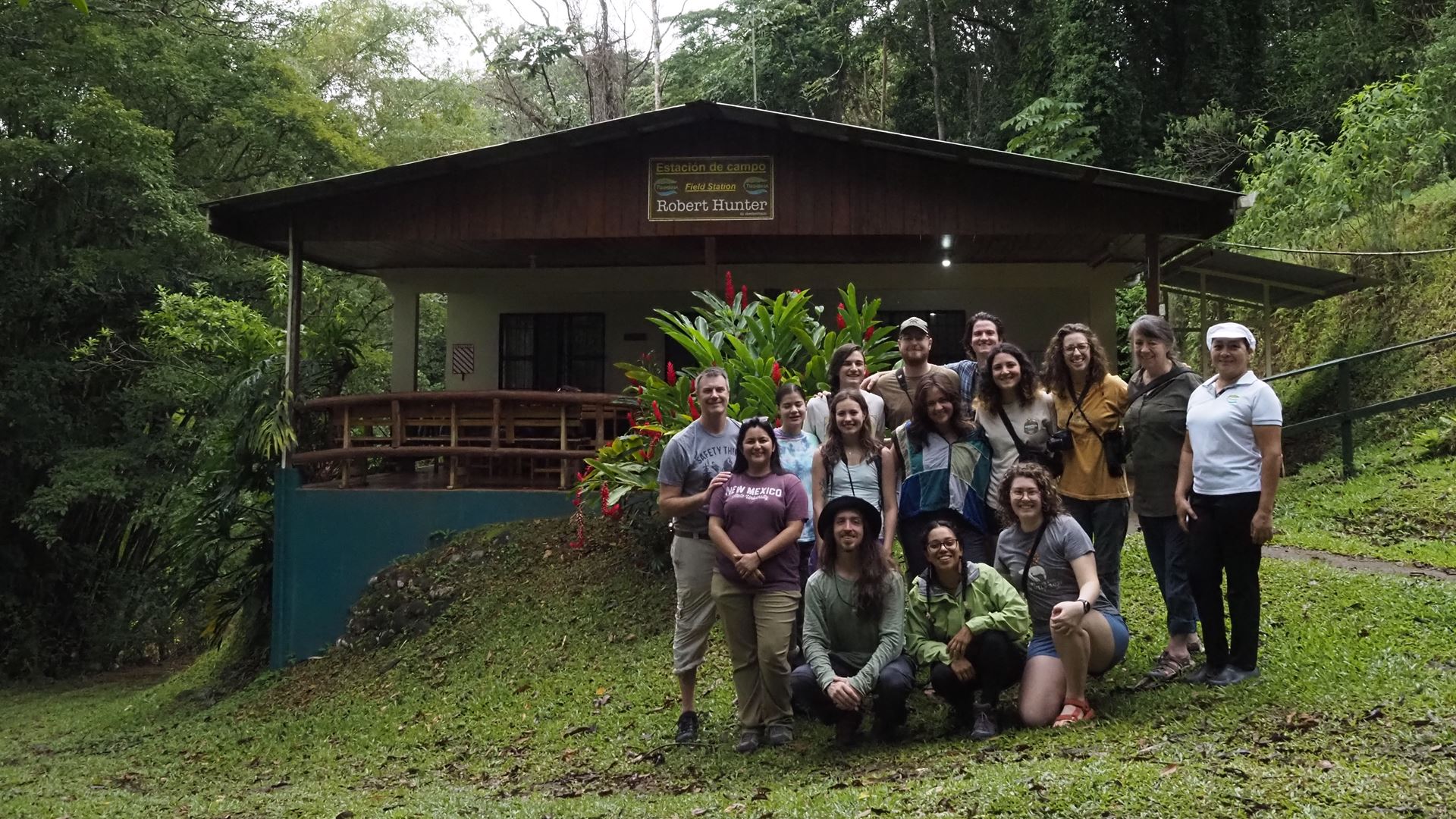
Through it all, students are embraced by a community of like-minded, passionate scientists and conservationists. Student-led mixers, events and activities enrich their experience and build connections, and the program’s biennial trip to Costa Rica offers an exciting chance to study migratory bird biology in the field.
“We’re really proud of what our students have been accomplishing,” said Timothy Wright, biology professor and head of the Avian Migration Program. “What they’ve shown by persevering through this research, by growing as scientists and conservationists and by continuing to show the belief that they can make this a better world – those are my points of pride.”
The program continues to support students as it heads into its fifth year. 15 students have graduated, including four graduate students and 11 undergraduates, and four students have recently published papers from their work in the program. Those students; Dylan Osterhaus, Kelley Boland, Alexander Allison and Thomas Huycke, exemplify what is possible in the Avian Migration Program.
“This was definitely one of the best and most productive things that I did during my time at NMSU, and one of the most helpful for me in terms of my development as a scientist,” Osterhaus said. “My experience in the program was amazing. Getting to do things together like birding or the field trip to Costa Rica with people who have similar interests and research goals really built a close-knit community, and this program was the backbone that brought everyone together. Working with the people here made my time at NMSU really special.”
Wright and Martha Desmond, Regents professor, head of the fish, wildlife and conservation ecology department and co-director of the Avian Migration Program, led a team of researchers to establish the program in response to a large-scale avian mortality event that affected migrating bird populations across the Southwest. Osterhaus, one of their first students in the program, studied this event throughout his time at NMSU. He graduated with his Ph.D. in biology in 2025 and is now a post-doctoral researcher at Purdue University.
His work focused primarily on more than 600 bird carcasses collected from White Sands Missile Range in the weeks following the mass mortality event. He catalogued the variety of species that were present, as well as their ages, sexes and body condition, and found that the scale of the mortality event was likely due to a combination of long-term starvation and a major weather event during their migration.
“It’s a really striking paper,” Wright said. “It also brings our program full circle because if describes the avian mortality event that drove us to start the program in the first place.”
Osterhaus’ paper “Mass Mortality of Avian Migrants in New Mexico, USA, that Coincided with an Extreme Weather Event” is available here.
Kelley Boland, another of the program’s first students, graduated from NMSU with her master’s in fish, wildlife and conservation ecology in 2024. For her, the Avian Migration Program provided unexpected opportunities and a sense of community.
“It was a great group,” Boland said. “We did a lot together academically, professionally and socially. It was really fun to have this cohort of graduate and undergraduate students, as well as incredible mentors. We bounced ideas off each other, worked closely together and had a great support network among all of us.”
Like Osterhaus, her recently published work branched from the mass mortality event at White Sands Missile Range. She tested and compared human surveyors’ ability to detect bird carcasses in wide, open landscapes against those of trained scent detection canines, and her findings will help conservationists decide on the best method of sample collection for their research.
“This paper is hopefully going to give researchers implementing carcass surveys more information to work from,” she said. “Depending on the goals of their survey, it might be more useful to use humans to get an overall count, or to contract trained dogs and gain samples from a wider variety of species.”
Boland’s paper “Carcass size and ground substrate drive detection rates of avian carcasses by human surveyors and a dog team” is available here.
While in the Avian Migration Program, Osterhaus and Boland co-mentored Thomas Huycke, who graduated with his bachelor’s in fish, wildlife and conservation ecology this spring. Huycke’s project studied the longevity of bird carcasses on the desert landscape, including on the White Sands Missile Range during the mass mortality event. He set out carcasses across the desert and used camera traps to measure how long the carcasses persisted before being taken by other animals.
Huycke’s work helps conservationists more accurately estimate the total number of birds affected by an event like the mass mortality at White Sands Missile Range. While the sudden presence of many bird carcasses might be a good thing for the local wildlife in need of food, scavenging causes an issue for scientists trying to estimate the extent of the mortality event. Huycke’s work helps researchers account for the carcasses that were related to the event but missing from the scene because of scavenging.
Huycke’s paper “Rapid scavenging of avian carcasses in the desert Southwest: Implications for mortality surveys not associated with infrastructure” is available here.
Alexander Allison spent his time in the Avian Migration Program studying an entirely different subject – the critically endangered great green macaw. Estimates suggest that less than 1,000 of these birds remain in the wild, and their shrinking population is divided into geographically isolated regions across the rainforests of Central and South America.
Allison’s work explored the vocal patterns of macaws within different groups. He aimed to determine if separate groups of macaws had developed different communication styles, and if those unique styles would prevent effective communication between different populations. His work did not find any notable communication barriers between geographically separated populations, meaning that future conservation efforts can bring these groups together to help stabilize the number of great green macaws in the wild.
Allison’s paper “Vocal development and patterns of vocal variation inform conservation of a critically endangered macaw” is available here.
Allison graduated from NMSU with his master’s in biology in 2025. Like Osterhaus and Boland, he fondly remembers the Avian Migration Program as a place of community, opportunity and a shared love of birds.
“It was a great program to be a part of,” he said. “It’s an important part of graduate school to find supportive communities, and it was great to have that group to get together with and share our ideas and enthusiasm for our projects.”
-30-
CUTLINE: The Avian Migration Program at New Mexico State University prepares undergraduate and graduate students for careers in avian conservation and resource management. It includes hands-on learning and research experiences, professional development opportunities and a biennial field work trip to Costa Rica. Pictured here from back left: Danny Tipton, Dylan Osterhaus, Alexander Allison, Tim Wright, Leona Crowl, Samantha Aguilar, Fatima Quiroz, Coral Matos, Kelley Boland, Martha Desmond, Carla (Tirimbina Field Station Cook), Cynthia Dunkleberger, Thomas Huycke, Ana (local trip host) and Whitney Watson. (Courtesy photo)
CUTLINE: Students in New Mexico State University’s Avian Migration Program conduct field work on their biennial trip to Costa Rica. (Photo courtesy of Kelley Boland)
CUTLINE: A great green macaw flies through the trees in Costa Rica, photographed by New Mexico State University and Avian Migration Program alumnus Alexander Allison, during the program’s biennial field trip to Costa Rica. (Photo courtesy of Alexander Allison)
CUTLINE: Dylan Osterhaus, New Mexico State alumnus and one of the Avian Migration Program’s first students, photographed this Wilson’s warbler during a community outreach event put on by the Avian Migration Program at the Mesilla Valley Bosque State Park. (Photo courtesy of Dylan Osterhaus)