
In 2022, 19 cattle and 19 elk were found dead from suspected plant poisoning at a New Mexico ranch. Three years later, 10 additional cattle and an unknown number of elk died from the same issue – toxic plants – at the same ranch, which spans about 24,000 acres, making traditional ground assessments impractical.
Since then, Casey Spackman, a range management specialist for New Mexico State University’s Cooperative Extension Service, has made it his mission to find an effective solution in identifying toxic plants across extensive landscapes. He has zeroed in on unmanned aerial systems, also commonly known as drones.
Spackman’s research may change how toxic plants are detected and addressed in southwestern New Mexico. Instead of relying on time-consuming field surveys, land managers can use drone-based artificial intelligence maps to locate toxic plants and respond quickly by strategically altering grazing management, Spackman said. This could ultimately reduce or avoid livestock losses.
“Before artificial intelligence, analyzing drone imagery was largely a manual process,” Spackman said. “After each flight, researchers had to visually inspect thousands of images to look for potential toxic plants. This required significant time and expertise, and subtle or scattered plant populations were easy to overlook. While drones provided a new perspective, the ability to efficiently interpret the imagery remained a major limitation.”
Spackman said necropsies of the deceased animals revealed seeds from the Caryophyllaceae family in their stomachs, suggesting that a toxic plant was the likely cause of death. The seeds most closely matched Drymaria arenarioides, commonly referred to as alfombrilla, a toxic plant species native to Mexico that had not been previously documented in the United States.
Spackman received initial external funding from the New Mexico Department of Agriculture to locate and manage Drymaria arenarioides on New Mexico rangelands. That funding helped Spackman establish the project’s early stages and develop the first version of the toxic plant detection models.
“The potential presence of this species in New Mexico raised significant concerns, prompting coordination among researchers, state agencies and federal partners, including the U.S. Department of Agriculture’s Animal and Plant Health Inspection Service,” Spackman said. “Beyond explaining a single mortality event, the discovery suggested the possibility that a previously undocumented toxic plant may be establishing itself on Southwestern rangelands, highlighting the need for improved detection and monitoring tools.”
Graduate and undergraduate students play a central role in Spackman’s project, including drone operations, data collection, image labeling and the development of artificial intelligence tools used to identify toxic plants. Students are also invited to participate in outreach and communication efforts to help share project findings with land managers and stakeholders.
“For students, the project provides a unique opportunity to work at the intersection of rangeland science and emerging technologies,” he said. “Students gain hands-on experience with drones, data analysis and artificial intelligence, while contributing to a real-world problem that affects producers and ecosystems in New Mexico. Through this work, they develop practical skills and a deeper understanding of how technology can be applied to natural resource challenges.”
The project is influenced by both seasonal conditions and the pace of research development, Spackman said. Toxic plants are most visible at certain times of the growing season, so drone flights and field verification must be carefully timed to capture them when they are most easily identified.
“In addition, developing and refining the artificial intelligence tools requires an iterative process of data collection, testing and validation,” he said. “At the same time, there is a practical sense of urgency: The sooner toxic plants can be identified and mapped, the sooner land managers can take steps to reduce risks to livestock and wildlife. Together, these factors shape the project’s timeline and direction.”
Spackman is currently seeking funding to expand the project to additional toxic plant species.
A version of this story appears in the spring 2006 issue of ACES Magazine. For more stories, https://nmsu.news/ACES-Magazine-Spring-2026.
-30-
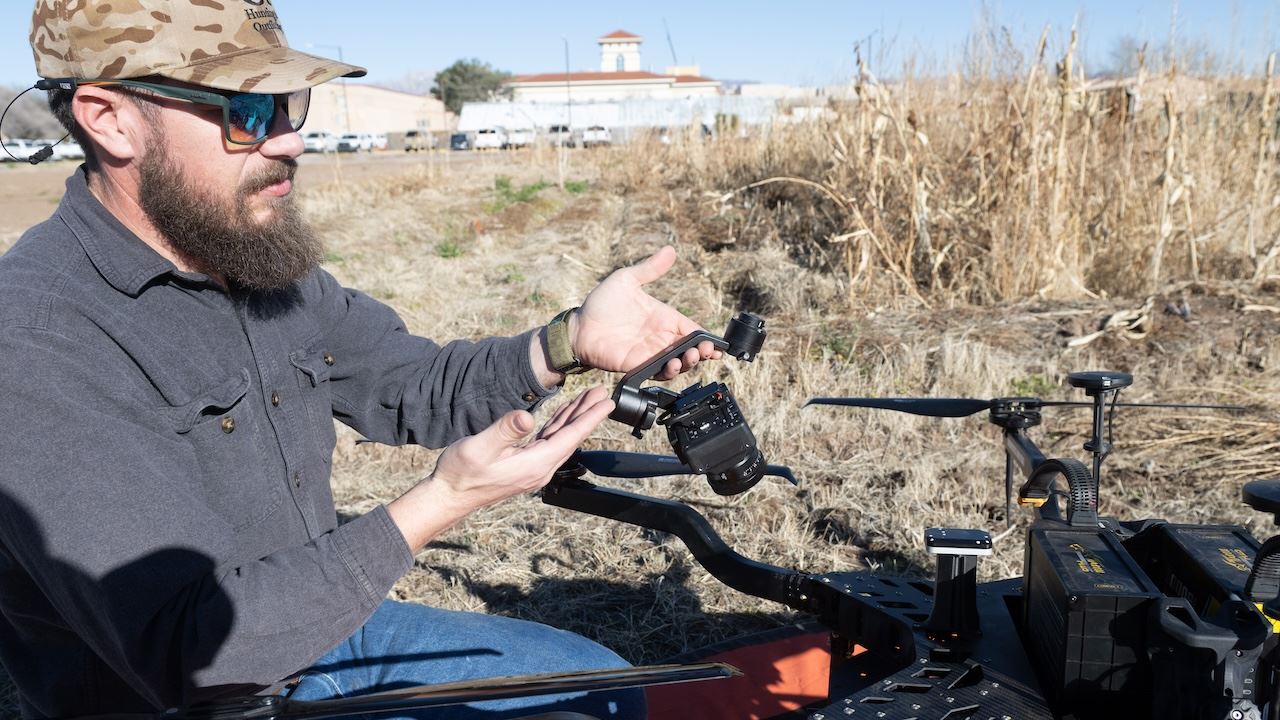
Cutline: Casey Spackman, a range management specialist for New Mexico State University’s Cooperative Extension Service, prepares to fly a research drone over the Las Cruces campus. (NMSU photos by Josh Bachman)
Man holding a drone.