
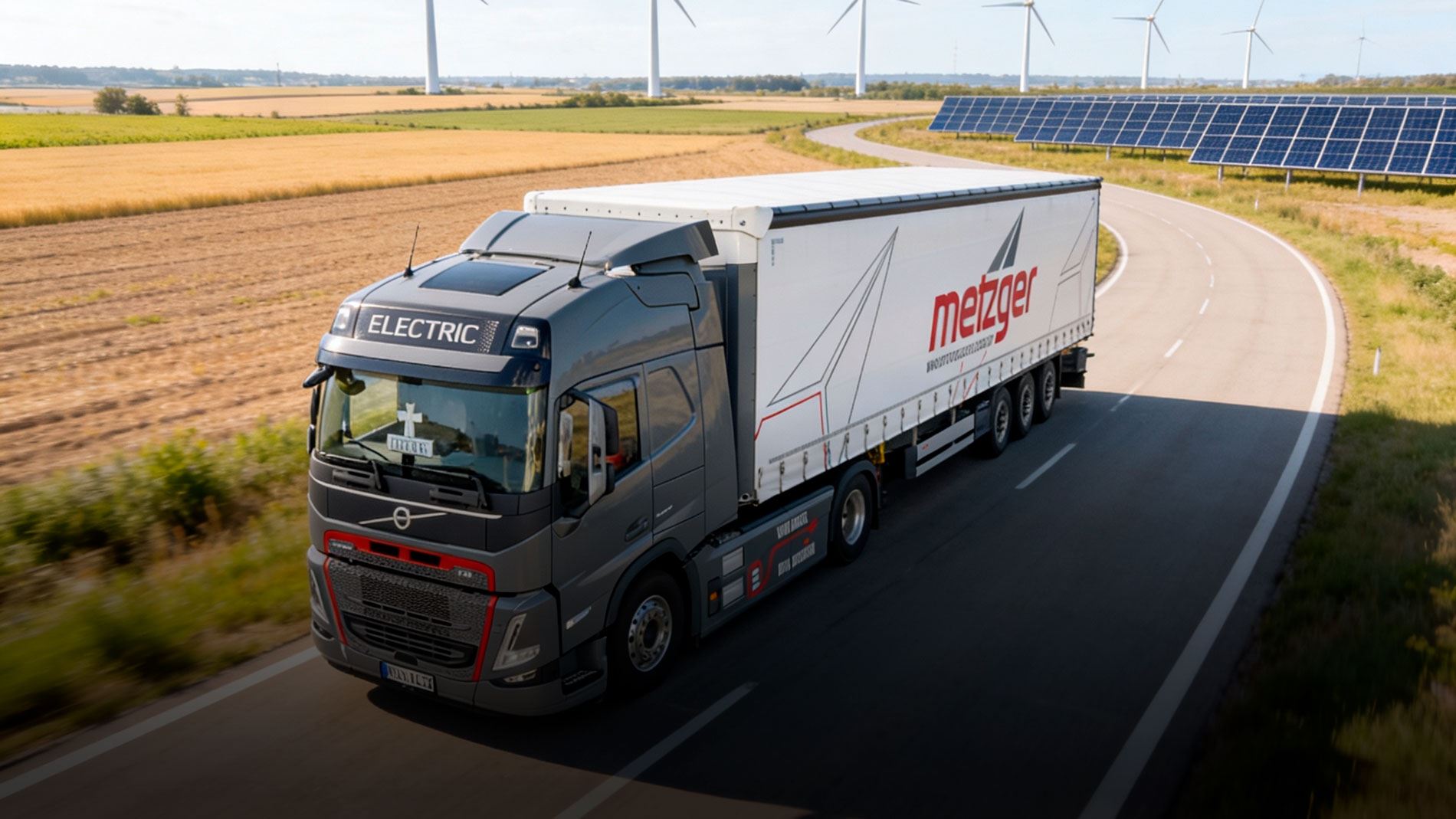
E-trucks are moving beyond the trial phase in logistics. At the medium-sized company Metzger, it becomes clear what already works today and why manufacturers such as Volvo Trucks and MAN have to think beyond simply selling vehicles, taking energy, charging and planning issues into account as well.
At the Metzger haulage company in Baden-Württemberg, the electric truck is no longer an exotic trade fair vehicle. It is part of the fleet, charges at the loading bay and runs fixed routes. Johannes Metzger is the third generation to run the family business. “I have now been working in my parents’ company for ten years,” he says in conversation with GATEWAY, “I am the third generation now holding the steering wheel.”
Metzger now has five electric trucks in operation, within a fleet of 25 to 30 vehicles. It began almost exactly five years ago: “The first one joined the fleet on 10 June 2021 with its initial registration, a twelve-tonner.” With its own charging infrastructure, the trial became part of everyday operations: “With the charging infrastructure, we moved into regular operation.”
Today, Metzger does not operate just one brand. “We have electric Volvos, we have electric MANs and also Daimler trucks,” he says. “We have the largest manufacturers there, and we maintain a very good relationship with all of them.” The decision is less ideological than operational: “You simply have to find the right vehicle for your use.”
The market itself is still small. According to ACEA figures, electrically chargeable trucks over 3.5 tonnes accounted for only 4.2 per cent of new registrations in the EU in 2025. But the technical debate has shifted. Volvo Trucks speaks of a range of up to 700 kilometres for the FH Aero Electric. Benjamin Schiebler of Volvo Trucks translates this figure into practice: “In daily operation, haulage companies deliberately plan with reserves, for example for traffic or changing weather conditions. In practice, this means that routes of around 600 kilometres can be carried out reliably and predictably without public charging en route.”
From truck to an overall system
The decisive factor is no longer just battery size. “For us, it is remarkable that, as a truck manufacturer, we are now being asked about charging infrastructure,” says Schiebler. “Naturally, no one asks us about the number or location of diesel filling stations.” This, he says, shows how fundamentally the industry is changing: “Today, we no longer just deliver the truck. We talk just as much about depot charging, public charging points, energy supply, battery storage and route optimisation. Electromobility really is an overall system.”
At MAN, the message is similar. “In the past, we had only a single product,” says Dennis Affeld, Managing Director of MAN Truck & Bus Germany. “Now we have the full range of models - from light distribution transport, through the electric TGM, to construction-site transport with the electric TGS and long-distance transport with the eTGX.”
Sales are changing too. “When you sell a diesel truck, it is primarily a vehicle business,” says Schiebler. “Selling an electric truck, by contrast, is more like a project business that goes far beyond the vehicle itself.” With an e-truck, he says, it is “indeed moving towards an overall system.“
Continue reading on Gateway to Automotive.