
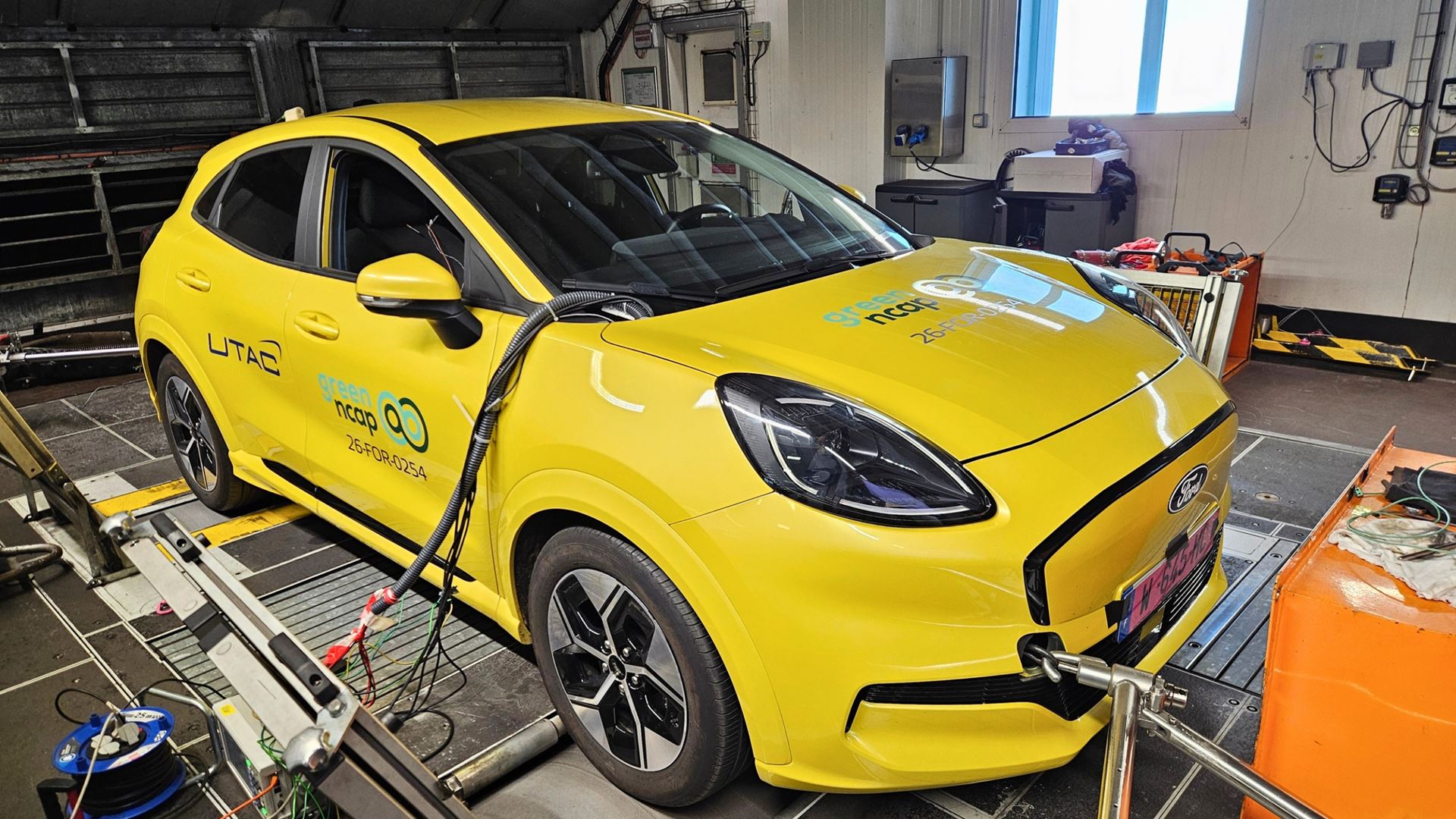
- Popular Ford Puma Gen-E sets the efficiency standard for smaller, compact electric cars
- Puma’s 9.8/10 Energy Efficiency score outperforms most EVs
- BYD DOLPHIN G showcases the advantages of a plug-in hybrid
- Toyota C-HR plug-in hybrid offers little benefit over already impressive standard hybrid
- The Audi Q3 e-hybrid proves that a luxury SUV can deliver high performance if its PHEV system is tuned efficiently
LEUVEN, BELGIUM – When even the most intense of test drives does not paint a true picture of a new car’s efficiency and range, it can be difficult for car buyers to know which vehicle to choose. Green NCAP plugs that knowledge gap, by independently assessing new cars’ efficiency, charging speeds, driving performance and overall environmental impact – and making the information freely available to consumers.
Ford Puma Gen-E: a new efficiency standard for EVs
- Ford Puma Gen-E
Sustainability Rating: 5 stars | 96%
In Green NCAP’s latest tests of some of Europe’s most popular SUVs, the Ford Puma Gen-E delivers a stand-out performance that matches some of the most efficient electric cars the organisation has ever assessed.
Scoring an impressive 9.8/10 for Energy Efficiency, the Puma offers drivers, the practicality and performance that most buyers demand from new models. To date, only the Dacia Spring, a smaller, lighter economy car has scored higher in efficiency tests.
The Puma’s overall Sustainability Rating of 96 per cent will be reassuring to consumers who want to own a small, compact electric SUV and are conscious of its environmental footprint. The car makes a strong case for itself despite its limited long-distance range thanks to a relatively small 54-kWh battery, excellent energy management and quick recharging speeds.
Across all tests – including highway driving and -7°C cold-weather conditions, despite lacking a heat pump – the Puma Gen-E records remarkably low electricity consumption, as low as 13.3 kWh/100 km on the road. In day-to-day driving, Green NCAP estimates a real-world range of 303 km (188 miles) in warm mixed driving and 190 km (118 miles) in cold winter conditions, while fast DC charging takes the battery from 10 to 80 per cent in just over 24 minutes.
Combined with zero tailpipe emissions and European manufacturing, it achieves a maximum 10/10 score for Greenhouse Gases, limiting life cycle emissions to just 102.5 g CO2-eq./km, making it one of the least environment impactful electric cars to be assessed by Green NCAP.
Spotlight on plug-in hybrids
Plug-in hybrids (PHEVs) have become popular across Europe, particularly in the current context of rising fuel prices. Manufacturers are trying to strike a balance between reducing CO2 emissions and providing cars that offer more flexibility for consumers and meet their practical needs. Whilst it is important to note the financial and environmental benefits of a plug-in hybrid are only when the car is driven electrically and depends on the user’s driving habits and the journeys they take, Green NCAP’s recent testing of three popular models reveals the considerable differences between them. To maximise the full potential of PHEV’s Green NCAP strongly encourages consumers to start their journeys with a fully charged battery and recharge frequently.
- BYD DOLPHIN G
Sustainability Rating: 4 ½ stars | 88%
Leading the trio with an overall Sustainability Rating of 88 per cent, the BYD DOLPHIN G DM-i Comfort demonstrates how effective a well-engineered plug-in hybrid can be when driven primarily on electric power. Thanks to its 18.3-kWh battery, the compact hatchback achieves 97 km (60 miles) of pure electric range in Green NCAP’s testing and completes the entire -7°C cold winter test without starting its petrol engine. It records strong scores across Clean Air (9.0/10), Energy Efficiency (8.3/10) and Greenhouse Gases (9.3/10), helped by its relatively low mass (1575 kg), effective regenerative braking and manufacturing data, which has been supplied by BYD and independently verified by Green NCAP experts. Total life cycle emissions are calculated to be an impressive 124 g CO2-eq./km. With the tested version, drivers also benefit from scheduled and remote-controlled seats and steering wheel heating, effective cabin thermal insulation and quick heat-up in cold weather, though rear footwell heating lags in contrast to the rest of the cabin.
- Audi Q3 e-hybrid
Sustainability Rating: 4 stars | 77%
The Audi Q3 e-hybrid 200 kW earns a 77 per cent Sustainability Rating, a respectable score that illustrates how even 1.9-tonne luxury SUV can perform well if its PHEV system delivers the right mix of electric driving. In Green NCAP’s testing, the Q3 delivers 106 km (66 miles) of pure electric range and completes the entire -7°C winter test in EV mode. Exhaust emissions are well controlled across all conditions – helping earn an overall 8.5/10 for Clean Air – while its high electric driving share helps limit life cycle greenhouse gas emissions to 149 g CO2-eq./km (7.9/10). However, its 1906-kg mass, high rolling resistance and elevated electricity consumption – particularly in cold weather (31.3 kWh/100 km) and on the highway – hold its Energy Efficiency score to 6.9/10, while battery and vehicle production account for a substantial share of its overall environmental footprint.
- Toyota C-HR Plug-in Hybrid
Sustainability Rating: 4 stars | 70%
Whilst the BYD and Audi plug-in hybrid systems do prove their merit, the Toyota C-HR 2.0 Plug-in Hybrid is found to offer few advantages over the already impressive standard C-HR Hybrid. Its 70 per cent Sustainability Rating is a little better than the standard hybrid C-HR (66 per cent). It is held back by the comparatively small 13.6-kWh battery, which limits both range and the driving mix performed in EV mode, meaning its petrol engine must run more frequently compared to the other two PHEVs. Unlike the BYD and Audi, the C-HR PHEV cannot complete the -7°C cold winter test in pure electric mode, as the combustion engine starts immediately. While it is quick to warm-through and retains heat well thanks to a standard heat pump and smart zone heating, that reliance on the combustion engine elevates particle and hydrocarbon emissions and limits its scores to 7.1/10 for Clean Air, 7.4/10 for Energy Efficiency and 6.7/10 for Greenhouse Gases, with life cycle emissions reaching 172 g CO2-eq./km.
These latest results highlight that the badge on the back of a car only tells part of the story. The Ford Puma Gen-E proves that a practical, every day, compact, electric SUV can rival the smallest city cars in energy efficiency, keeping both running costs and life cycle emissions remarkably low.
Meanwhile, our plug-in hybrid tests show a clear divide: models with generous electric range that can stay in EV mode even in freezing winter weather deliver genuine environmental benefits, whereas PHEVs with smaller batteries that rely more on their petrol engines offer fewer gains – especially if drivers do not plug them in regularly.Dr. Aleksandar Damyanov, Technical Manager Green NCAP