
For years, digital visibility was measured through familiar indicators: website traffic, engagement, reach and search rankings.
The logic was simple: publish the right content, place it in the right channels, and your audiences would find it.
Today, that logic is changing.
With the rise of AI-powered search and answer engines, people no longer always browse through pages of results. Increasingly, they ask a question and expect a clear, immediate answer.
For communication teams, this creates a new challenge: content must not only be published. It must be easy to understand, trustworthy and structured enough to be surfaced in AI-generated responses.
From search results to direct answers
Traditional search engines gave users a list of links. People compared sources, opened websites and decided what to trust.
AI systems work differently.
Whether through ChatGPT, Perplexity or AI-powered search experiences, users increasingly expect information to be summarised for them. In some cases, they may never visit the original website at all.
This has important consequences for corporate communications.
Visibility is no longer only about ranking in search results. It is also about becoming part of the answer.
The content an organisation publishes today can influence how journalists, investors, policymakers, employees and customers understand that organisation tomorrow.
Why owned content is becoming strategic again
Over the past decade, many organisations have focused heavily on social media and third-party platforms.
Corporate websites and newsrooms often became places to store press releases, reports and official announcements, while attention shifted to external channels.
But these platforms have limits.
Algorithms change. Reach fluctuates. Audiences move. Priorities evolve.
Owned channels are different.
A corporate website, newsroom or content hub remains one of the few spaces fully controlled by the organisation. It is where companies can bring together their stories, data, expert voices, leadership perspectives, media assets and official information.
In an AI-driven discovery environment, this matters more than ever.
Not necessarily because audiences are suddenly returning to corporate websites in large numbers, but because AI systems may use this content to understand what an organisation does, what it stands for and where its expertise lies.
Quality content matters more than ever
One of the most interesting effects of AI is that it could make high-quality content more valuable, not less.
For years, communication teams have been told that audiences only want short-form content. But the success of podcasts, newsletters and long-form thought leadership tells a different story.
People still spend time with content when it is useful, relevant and well written.
AI systems also tend to rely more easily on content that is clear, structured, informative and authoritative.
This means that vague corporate language, generic claims and repetitive messaging are less likely to stand out.
The organisations that succeed will be those that publish content with real substance: clear explanations, useful insights, consistent messaging and demonstrable expertise.
Communications teams need to think like publishers
The idea that brands should “think like publishers” is not new. But AI is making it more urgent.
Every piece of content now contributes to a wider ecosystem of visibility.
Press releases, articles, executive commentary, reports, videos, images, FAQs and media resources all help shape how an organisation is interpreted by people and by AI systems.
This means content should not be treated as a series of isolated campaigns.
Instead, communication teams need to build a connected body of knowledge: clear, consistent and accessible information that can be discovered, understood and reused across different channels and audiences.
This is not only a technology issue.
It is an editorial issue.
Organisations that invest in strong content strategies, structured information and authoritative resources will be better positioned to influence how they are represented in AI-generated answers.
What should communication teams do now?
The fundamentals of communication are not disappearing.
Organisations still need to understand their audiences, create valuable content, communicate consistently and demonstrate expertise.
What is changing is the way that content is discovered and consumed.
As AI becomes a new gateway to information, communication teams should ask themselves:
- Is our content easy to find, read and understand?
- Are we publishing enough authoritative information on our owned channels?
- Do our websites and newsrooms clearly reflect our expertise and priorities?
- Are our key messages consistent across articles, reports, press releases and corporate pages?
- How visible is our organisation in AI-generated answers?
These questions may soon become as important as traditional measures of digital visibility.
Join the conversation
These are some of the topics we will explore in our upcoming epresspack webinar:
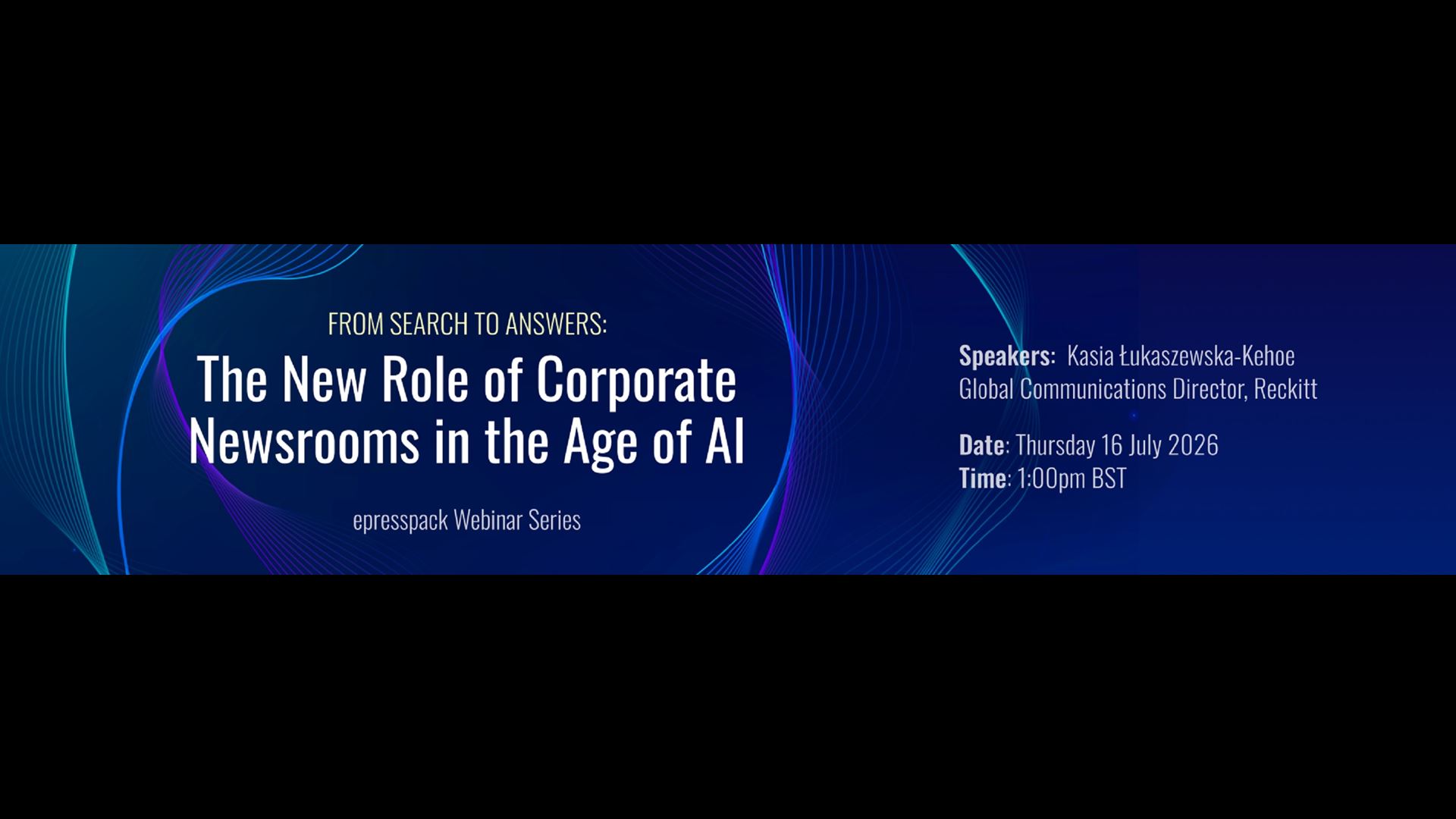
From Search to Answers: The New Role of Corporate Newsrooms in the Age of AI
John Gaylor of epresspack will be joined by Kasia Łukaszewska-Kehoe, Global Communications Director at Reckitt, to discuss how communication teams can adapt their content strategies and strengthen visibility in an increasingly AI-mediated world.
Date: Thursday, 16 July 2026
Time: 1:00 pm BST