
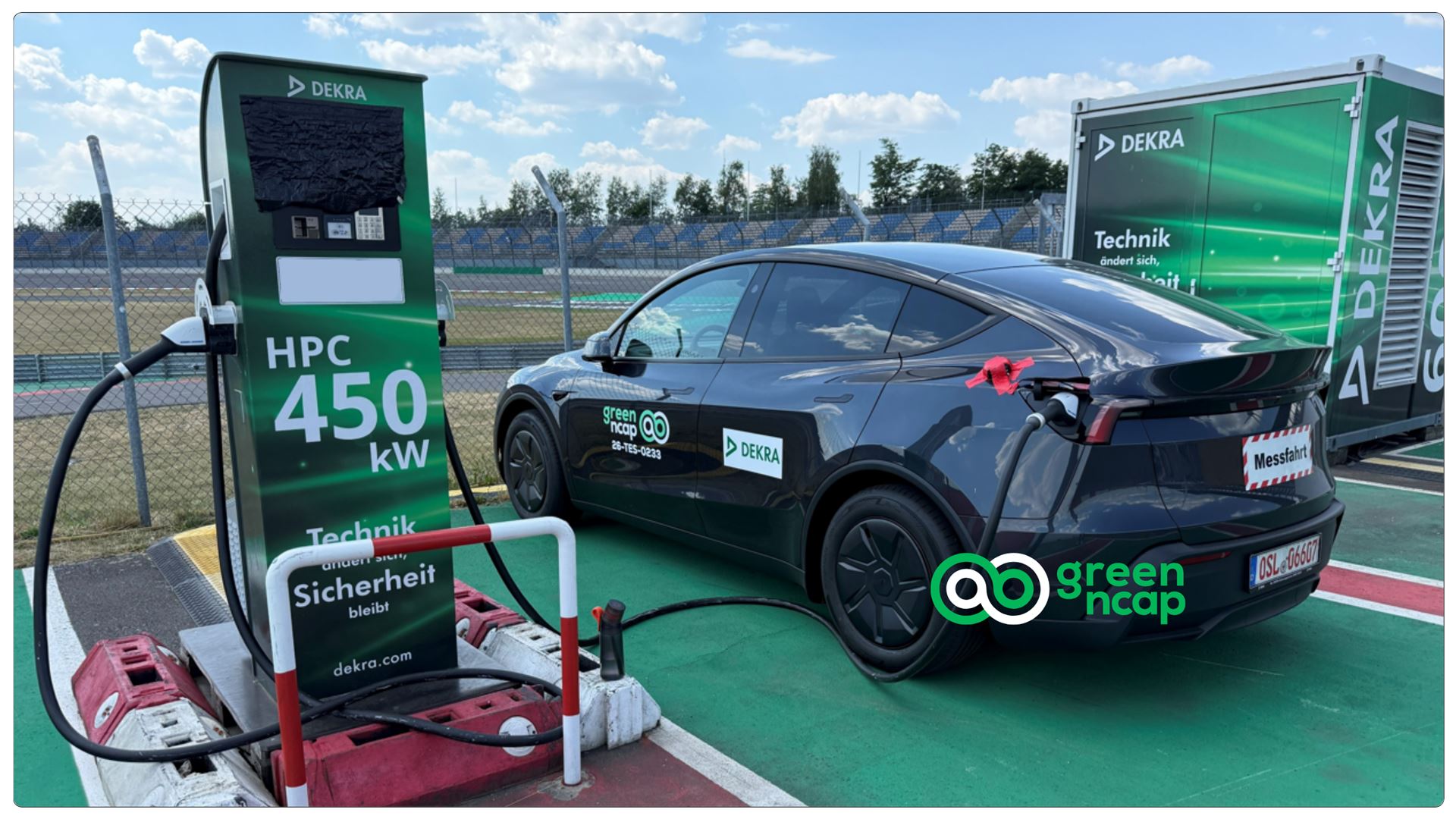
- Green NCAP awards the electric Tesla Model Y a maximum five-star Sustainability Rating.
- Tesla shares comprehensive Life Cycle Assessment (LCA) data with Green NCAP for the first time, demonstrating OEM best-practice transparency.
- Comparison between the electric Tesla Model Y and petrol-powered Volkswagen Tayron shows how EV powertrains can effectively reduce the environmental impact compared to a similarly sized conventional car.
- Green NCAP also reveals Sustainability Ratings for the electric BYD DOLPHIN SURF and Suzuki e VITARA, as well as the diesel-powered Volkswagen Golf.
LEUVEN, BELGIUM – Consumers can better understand the real environmental impact of Europe's best-selling electric car*, as Green NCAP publishes its Sustainability Rating for the Tesla Model Y.
In a major milestone, Green NCAP has independently assessed the whole-life impact of the Berlin-built Model Y, an electric SUV, including the sourcing of raw materials, manufacturing process, distribution and daily operation. This in-depth analysis, made possible by Tesla’s transparent approach in sharing data with Green NCAP, offers consumers an unrivalled overview of how Tesla has successfully minimised the impact of this popular SUV, which was bought by 150,000 European drivers last year. Achieving a maximum five-star Sustainability Rating, the Model Y is particularly praised by Green NCAP’s experts for its low levels of Greenhouse Gases associated with the manufacturing and operating phases of the car’s life.
The latest round of environmental testing highlights how optimised electric powertrains can deliver remarkable real-world efficiency – even in larger family SUVs. In comparison, the Volkswagen Tayron is a mild-hybrid petrol SUV with a Sustainability Rating that falls far behind Tesla’s Model Y. In the compact car category, BYD’s DOLPHIN SURF, achieves a five-star rating, following up on the electric hatchback’s similarly strong showing in Euro NCAP safety tests.
Green NCAP testing also shows that despite past controversies, modern diesel-powered cars can be highly efficient and clean and still earn a worthy place on the market for some consumers. The Volkswagen Golf 2.0 TDI (which has related models in Audi, SEAT and Škoda showrooms) narrowly missed out on a four-star Sustainability Rating.
- Tesla Model Y (62.6 kWh RWD)
Sustainability Rating: 5 stars | 93%
The Tesla Model Y delivered an outstanding performance, securing a flawless 10/10 score in Greenhouse Gases thanks to impressive efficiency and verified Life Cycle Assessment (LCA) data. Although not particularly light (at 1.9 tonnes), the single-motor Rear-Wheel Drive SUV achieved a total lifecycle carbon footprint of just 95 g CO2-eq./km, making it one of the standout cars assessed by Green NCAP.
In real-world driving conditions, the Model Y demonstrated strong energy efficiency and quick cabin heat-up in cold weather. Equipped with an efficient heat pump, and with an impressively well-insulated cabin, it maintained interior temperatures exceptionally well, showing minimal thermal drop 30 minutes after power-down at - 7°C. Charging performance was equally efficient, completing a 10 to 80 per cent DC fast charge in just 24 minutes. While the current model lacks bidirectional charging capabilities (V2L/V2G) – its balance between powertrain architecture, battery design and overall management makes it a benchmark for electric SUV efficiency.
- BYD DOLPHIN SURF (43 kWh)
Sustainability Rating: 5 stars | 96%
The BYD DOLPHIN SURF performed exceptionally well for a compact electric hatchback, combining a light kerb weight with strong energy efficiency. In real-world testing, it delivered low energy consumption, effective fast charging (10 to 80 per cent in 33 minutes), and practical Vehicle-to-Load (V2L) bidirectional charging capabilities. Although its range is potentially a limiting factor for some consumers - an aspect constrained by vehicle and battery size - and the rear cabin heating could be improved, the DOLPHIN SURF fared admirably in its overall score.
The car is produced in China and was submitted for assessment with generic instead of verified specific production data. Its baseline lifecycle score is rather conservative, yet the vehicle’s low weight, small battery and noteworthy energy efficiency make it a top performer.
- Suzuki e VITARA (60 kWh)
Sustainability Rating: 4 ½ stars | 87%
The Suzuki e VITARA secured a strong 4-½-star rating, establishing itself as an efficient competitor in the compact electric SUV market. Besides the measured low consumption values, a standout performance was the efficiency recorded in grid-to-battery-output 11 kW wall box charging, ensuring minimal energy goes to waste.
However, its environmental score was limited by its weight (1.8-tonnes) and an LCA profile impacted by the generic assumptions made for production in India. Driving evaluations revealed good consumption in most testing scenarios, though testers noted inaccuracies in the trip computer display, subsequently addressed in a service campaign by Suzuki. The car also presented rather slow cabin heating in cold weather, and poor DC fast-charging speeds, requiring 44 minutes to charge from 10 per cent to 80 per cent.
- Volkswagen Golf (2.0 TDI)
Sustainability Rating: 3 ½ stars | 69%
Equipped with a 2.0-litre diesel engine, the Volkswagen Golf is the best performing combustion-engine vehicle yet tested by Green NCAP, with an overall score of 69 per cent. Operating with an effective emissions treatment system, the Golf recorded remarkably clean tailpipe emissions and outstanding fuel economy across all driving environments, maintaining excellent consumption even in freezing weather conditions.
This version of the Golf narrowly misses out on a 4-star rating (which has a 70 per cent threshold). Nonetheless, for those drivers who still appreciate diesel power, the Golf highlights the efficiency limits achievable by modern diesel engineering. And the good news is its related models – the Audi A3, SEAT Leon and Škoda Octavia – share the same Sustainability Rating.
- Volkswagen Tayron (1.5 eTSI DSG)
Sustainability Rating: 2 ½ stars | 41%
Green NCAP’s evaluation helps consumers choosing their next SUV easier. In contrast to the electric Model Y, the slightly lighter Volkswagen Tayron shows the stark differences drivers can face when choosing between a combustion-powered SUV and an electric version.
Achieving a Sustainability Rating of just 2 ½ stars, the petrol-hybrid Tayron suffered from heavy petrol consumption and a poor Greenhouse Gas rating, emitting a total of 263 g CO2-eq./km across its lifecycle, compared with 95 for the Model Y. While some will still value the convenience of being able to fill a tank of petrol in a few minutes and then make use of a generous driving range, the inherent environmental disadvantages of fossil-combustion power for an SUV are especially clear when compared with the Tesla Model Y.
Tesla is to be applauded for its transparent sharing of the data around the production of the Model Y and its battery. Going from generic LCA assumptions to verified manufacturer data allows the sustainability assessments to become even more accurate and to award those manufacturers, who invested in effective measures to notably reduce the climate impact of their products.
Significantly, the Sustainability Rating allows consumers to make a fully informed decision about buying their next car and consider whether everyday driving properties and environmental impact meet their expectations.
For those still in the market for a new conventionally powered car, Green NCAP is impressed by the latest iteration of the Volkswagen Golf. It delivers outstanding efficiency and minimal levels of harmful emissions, earning a firm place on European roads.
And for those looking for an electric city supermini, BYD’s DOLPHIN SURF has a lot to offer.Dr. Aleksandar Damyanov, Technical Manager Green NCAP
Editor’s note
*The Tesla Model Y was the best-selling new electric car in Europe and globally in 2025