
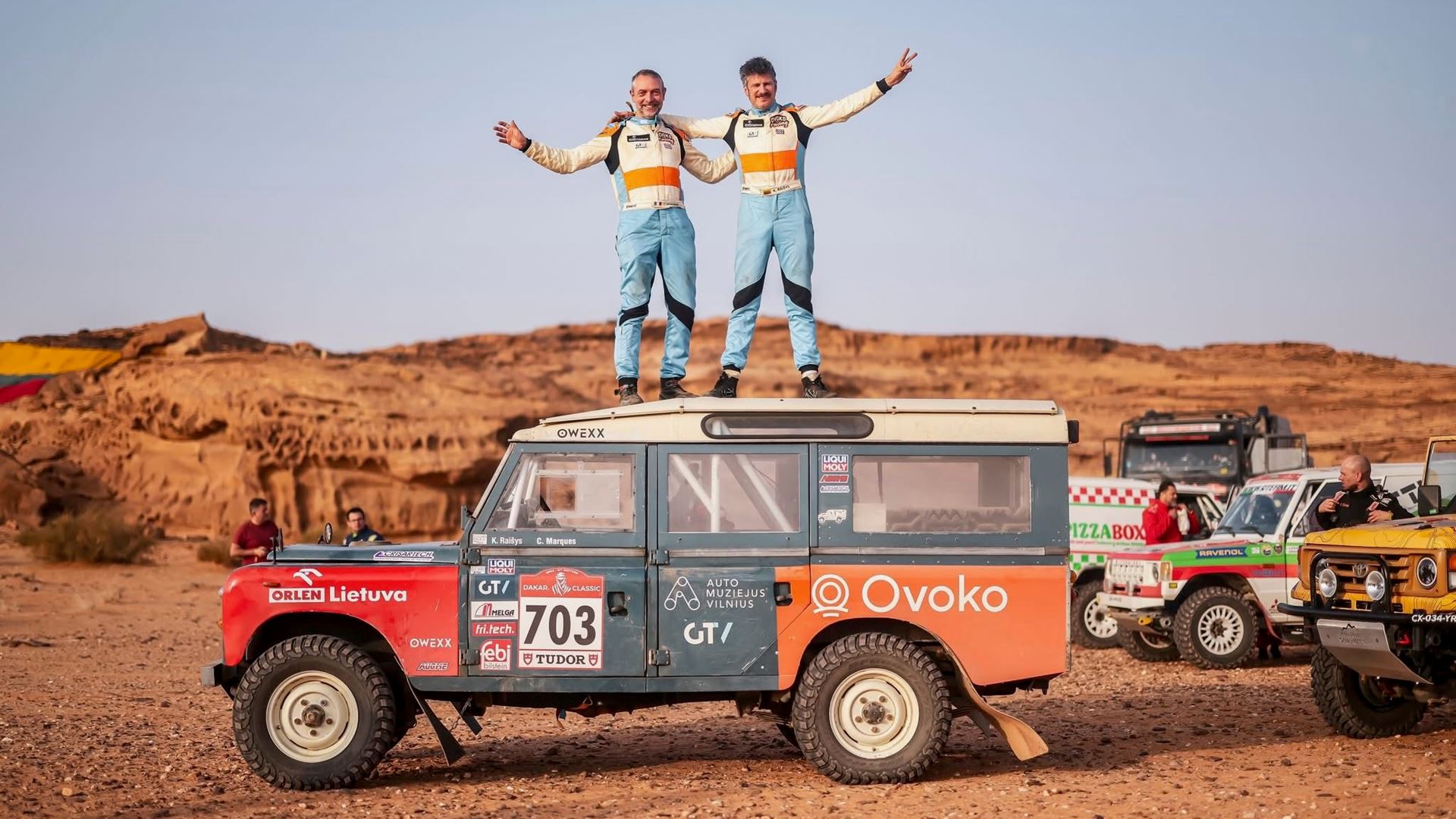
Three Lithuanian crews won major Dakar categories this year. But the real story is how a country of just 2.7 million people became one of the rally’s most remarkable nations.
At the finish of this year’s Dakar Rally, three major categories were won by Lithuanians. Crews from this small country took victory in the T1 category (Rokas Baciuška – Oriol Vidal), the truck category (Vaidotas Žala – Paul Fiuza – Max Van Grol), and Dakar Classic (Karolis Raišys – Christophe Marques). The news was surprising to those unfamiliar with Lithuania’s Dakar history. Those who follow the rally were less surprised.
Every year, around ten Lithuanian crews take part in the world’s toughest motorsport event: motorcycle riders, car crews and truck drivers. They come from a country of just 2.7 million people – a country far from the deserts and mountains, and far from the possibility of training there every day. Measured by the number of Dakar crews per 100,000 inhabitants, Lithuania is usually rivalled only by the Netherlands.
Thirty Years from Adventurers to Professionals
The first Lithuanian entered the Dakar Rally on a motorcycle back in 1996. There were failures at first. The first Lithuanian car crew reached the finish in the 2000 rally. By 2003, all three Lithuanian crews that started the rally – three cars and six people – reached the finish. They had no mechanics, support vehicles or spare parts.
I was one of them (first from left on the picture). We drove a Toyota Hilux with Arūnas Lekavičius. Early in the rally, we damaged the suspension of our lightly modified car, and the consequences followed us every day. Every day, we stopped on the route to make repairs, arrived at the bivouac at night and continued repairing the car there. After just a couple of hours of sleep, we were back on the starting line. Everyone had written us off long before the finish. People were amazed that those two exhausted, filthy zombies were still making it back to the bivouac.
And so it went for a couple of weeks. Before the finish, the car had only fourth gear left. The engine was consuming 20 litres of oil a day, the rear leaf springs were broken and the power steering had stopped working. But we made it to the finish.
Continue reading on Gateway to Automotive.