
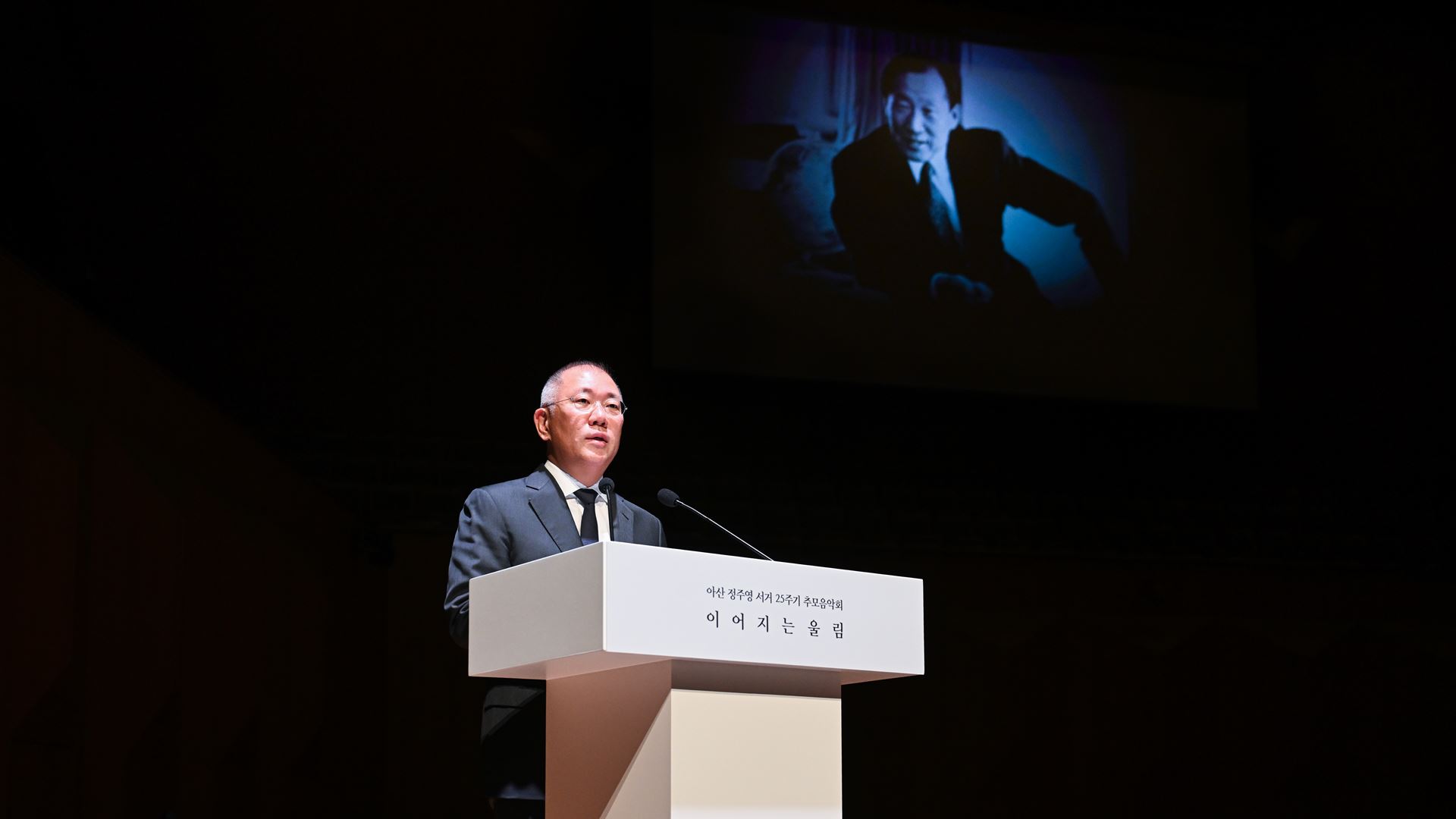
- Memorial concert themed “Resonance That Continues” held on February 25, 2026
- More than 2,500 attendees, including Hyundai Motor Group’s Executive Chair Euisun Chung and employees of the Group
- World-renowned Korean pianists Sunwook Kim, Yekwon Sunwoo, Seong-jin Cho and Yunchan Lim perform collaborative pieces
- Through masterpieces by Schubert and others, artists honor the late Founding Chairman’s lifelong dedication to people
- Founding Chairman Chung pioneered Korea’s industrial development with bold vision, unyielding determination and people-centered innovation
- Euisun Chung reaffirms commitment to inheriting the late founder’s philosophy of “innovation for people”
Hyundai Motor Group (the Group) held a memorial concert to mark the 25th anniversary of Hyundai’s Founding Chairman Ju‑yung Chung’s passing, honoring a spirit that transcends generations and still resonates today.
The Group hosted the “Memorial Concert for Asan Ju-yung Chung: Resonance That Continues” on February 25 at the Seoul Arts Center Concert Hall.
The late Founding Chairman is recognized as a pioneering business leader who forged Korea’s industrial foundation with bold vision, relentless determination and innovation for people. He ventured fearlessly into seemingly impossible fields and created entirely new paths — paths that always placed people and country at their end.
The Group organized the memorial event under the theme “Resonance That Continues,” underscoring how the late founder’s philosophy and life — dedicated to creating better lives for people — continue to echo powerfully across generations and expand into innovations for humanity.
Four of Korea’s leading pianists — Sunwook Kim, Yekwon Sunwoo, Seong-jin Cho and Yunchan Lim — participated in the concert, interpreting the late Chairman Chung’s life and spirit through piano performances.
The event drew more than 2,500 attendees, including major figures from government, business and various sectors; Executive Chair Euisun Chung; Founding Chairman’s family; and the Group’s employees.
In Executive Chair Chung’s memorial remarks, he expressed gratitude to attendees, stating, “We gather today to honor the profound resonance left by the late founder Ju‑yung Chung.”
Executive Chair Chung added, "My grandfather's beliefs and all his challenges began with 'people.' He had faith in the potential of people and achieved innovation for them."
Executive Chair Chung continued, "Although 25 years have passed, facing many difficulties and challenges both inside and outside our organization, that resonance resonates even more strongly with me and all of us today. Going forward, we will inherit my grandfather's spirit and create a better future," expressing his determination to continue pursuing people-centric innovation.
Executive Chair Chung also mentioned that this concert featuring four pianists was planned several years ago with pianist and conductor Sunwook Kim. Recalling the late founder Ju-yung Chung, he said, "If I had asked my grandfather about this, he would have said, 'Look! Why are you hesitating? Just do it!'"
The concert opened with Sunwook Kim and Seong-jin Cho performing Schubert’s “Fantasy in F Minor for Four Hands.” Yekwon Sunwoo and Yunchan Lim followed with Rachmaninoff’s “Suite No. 2 for Two Pianos,” after which all four pianists collaborated on Wagner’s “Tannhäuser Overture” and Liszt’s “Hexameron” on four pianos.
Through their performances, the pianists expressed not only the late founder Chung’s achievements — realized by challenging the impossible with a firm belief in people and a better future — but also the hope that his legacy offers to today’s generation. The finale, performed on four pianos, symbolized how individual challenges expand into collective resonance through collaboration and unity.
Pianist and conductor Sunwook Kim said, “This memorial concert offered a meaningful moment to rediscover Founding Chairman Chung, who shaped an era, through music. Music endures longer than words and sharing the weight and spirit of his life with the audience made the experience even more meaningful. It was unforgettable to share the stage with fellow pianists in a single breath, built on mutual trust.”
Pioneer of Korea’s Industrial Advancement With Bold Vision, Unyielding Resolve and Innovation for People
Automotive News, a renowned automotive industry media, recognized Executive Chair Euisun Chung, Founding Chairman Ju‑yung Chung and Honorary Chairman Mong‑Koo Chung with the Automotive News Centennial Award in 2025 for their outstanding contributions to the global automotive industry. Automotive News stated that “The Chung family as a whole played a seminal role in reshaping their country from the ashes of the Korean War into the global manufacturing powerhouse and automotive heavyweight known worldwide today.”
At the heart of such recognition lies the heritage that has continued from the late Founding Chairman Chung.
Born the eldest son of a poor farming family, Ju-yung Chung began with nothing in his hands. He started his working life as a dock laborer, a construction day worker and a factory errand boy. A rice shop he acquired through diligence and creditworthiness was forced to close due to the rice rationing system imposed during Japanese colonial rule. An auto repair shop he launched with all his assets — even taking on private loans — was lost to a fire less than a month after opening, leaving him in debt. A new repair shop and a civil engineering firm he later found also lost their assets during the Korean War, forcing yet another restart in the refugee city of Busan.
Despite these setbacks, the late Chung never gave in. He continually took on new challenges, ultimately building leading Korean enterprises in construction, automobiles and shipbuilding. He helped transform the nation’s industrial landscape and opened breakthroughs with innovation at every critical juncture for the Korean economy, leaving an indelible mark on the country’s development.
Choosing What Ultimately Benefits People
The name “Hyundai” embodies the entrepreneurial spirit of the late Founding Chairman in the 1940s — a time when Korea was poor — to pursue modernization so that everyone could live better.
He founded Hyundai Motor Service as an auto repair business in 1946 and Hyundai Civil Works Company in 1947. In 1950, he merged the two to establish Hyundai Engineering & Construction Co., Ltd. Following the war, he devoted himself to national reconstruction and economic revival by building bridges, dams, power plants and roads.
The late Ju-yung Chung consistently chose paths that, while difficult, would benefit people in the long term rather than yield short‑term gains. This is why he pushed for proprietary technology and entry into overseas markets. In a country short on resources and technology, he judged that technological self‑reliance and globalization were essential for corporate advancement and, ultimately, national prosperity.
While executing national reconstruction projects — from the Goryeong Bridge over the Nakdong River and the Hangang bridge to Incheon’s First Dock, as well as fertilizer plants, thermal power plants and dams — he focused not on simple subcontracting from advanced U.S. and Japanese firms but on building in‑house technological capability.
In addition, the late Founding Chairman recognized the constraints of the domestic construction market, which relied heavily on government-commissioned projects during the 1960s, and expanded internationally to win Korea's first overseas construction project—the Pattani-Narathiwat Expressway in Thailand.
In the 1970s, when the global oil shock plunged Korea into severe foreign‑currency shortages, the late Founding Chairman Chung entered the Middle East market and secured the Jubail Industrial Port project in Saudi Arabia. The contract totaled USD 930 million, roughly 20 percent of Korea’s annual government budget at the time, playing a critical role in easing the nation’s foreign‑exchange crisis and paving the way for other Korean builders to advance into the Middle East.
His drive to establish an automotive company and to champion the construction of the Gyeongbu Expressway also stemmed from a belief that creating roads and producing vehicles that would run on them would enrich people’s lives. Even when daily necessities were scarce, he foresaw the critical importance of free movement for people and logistics.
When he founded Hyundai Motor Company in 1967, he refused the easier route of becoming a simple production base for foreign makers. Instead, he chose the far more arduous path of developing independent models and localizing technology in what was then a wilderness for the automotive industry in Korea.
After countless trials, the late Founding Chairman succeeded in developing Pony, Korea's first mass-market model built on proprietary technologies. He then forged entirely new paths by opening export markets, expanding product lineups, securing proprietary powertrain technologies and localizing the parts value chain, laying a solid foundation for Korea’s automotive industry.
Through these efforts, the late Founding Chairman Chung created numerous jobs and opportunities for the nation’s young people.
When Hyundai bid for the Jubail port project — against the world’s leading builders — few were optimistic. Compared with global giants, Hyundai lacked technology, capital and overseas experience, and it even lacked a bid bond. With unwavering belief that “it can be done,” the late founder mobilized rigorous research, thorough preparation and every available network to win the contract.
Building a shipyard was also a string of obstacles. After repeated rejections for foreign loans — and even facing potential fraud — the late Ju-yung Chung doubled down on the effort to “make it work.” He ultimately found a capable loan arranger and signed technical cooperation agreements with A&P Appledore and Scott Lithgow in the U.K.
Armed with a grand vision for shipbuilding, he persuaded British banks, credit guarantors and shipowners to green‑light the shipyard project. A KRW 500 banknote printed with a Korea’s legendary armored “Turtle ship” of the 16th century and a photograph of the white sands of Ulsan’s Mipo Bay played a symbolic role in conveying his vision and Korea’s potential.
Korea’s successful bid to host the 1988 Seoul Olympics offers another emblematic example. When the late Founding Chairman Chung arrived in Baden‑Baden, Germany, as head of the private bid committee, Korea’s expected support was estimated at only three to four votes out of 82. He held daily strategy sessions, crafted tailored outreach plans to IOC members and mobilized stakeholders, expatriates and Hyundai employees to campaign tirelessly on the ground. He even decided to purchase entire flower fields to secure bouquets that would move IOC members. Through this relentless, hands‑on execution, Seoul defeated Nagoya 52–27, turning an unlikely scenario into reality.
Solving Root Problems and Breaking Molds to Open Unprecedented Paths
At every impasse, the late founder identified the real problem and solved it by breaking conventions — at times turning the issue into a new business opportunity.
During the shipyard’s construction and the simultaneous building of ships, the 1973 oil shock struck. Of the 12 VLCCs (very large crude carriers) on order, three were canceled or refused for delivery, and Hyundai was left to shoulder the burden. While many feared the losses, the late Founding Chairman turned crisis into opportunity by entering shipping: he launched a merchant shipping company with one refused vessel and two canceled orders, after completing them, thereby converting risk into growth.
In the Jubail Industrial Port project, Hyundai initially had to rent overseas marine equipment due to its lack of experience — and faced deliberate delays that jeopardized deadlines. The late Founding Chairman proposed a solution that stunned the industry: execute a large‑scale maritime transport operation by manufacturing all marine equipment, steel structures and concrete slabs in Korea and shipping them on giant barges to Saudi Arabia. Trusting Hyundai’s precision and the production capacity of the Ulsan shipyard, he shortened the schedule, demonstrated construction prowess and boosted the competitiveness of Korea’s heavy industry and shipping sectors.
The “oil‑tanker method” used at the Seosan reclamation site has become a textbook example of his inventive problem‑solving.
Believing that expanding arable land for future generations was as meaningful as creating jobs and advancing industry, the late Ju-yung Chung embarked on the reclamation of the Cheonsu Bay tidelands on Korea’s west coast. But the area’s extreme tidal range and strong currents posed severe challenges. Multiple attempts to connect the two sea walls for the final closure failed, as even boulder‑sized rocks were swept away by currents of 8 meters per second. The late founder recalled a large decommissioned huge vessel moored in Ulsan for scrap. Directing the on‑site work, he sank the vessel between the sea walls and completed the embankment — an unprecedented technique that came to be known as the “Ju‑yung Chung method,” or the vessel closure method.
His Positive Influence Continues Across Generations and Into the Future
A builder who established Korea’s industrial backbone through positive thinking, bold action, steadfast conviction and tireless effort; a creative entrepreneur unafraid of failure; a true humanist who valued the nation and its people as his own; and a wealthy laborer who lived a life of diligence, frugality and humility — the late Founding Chairman Chung’s spirit endures across the Group and all companies bearing the “Hyundai” name, driving efforts to create greater value for humanity and society.
The Group will continue striving for innovations that advance human well‑being and sustainability under Hyundai’s vision, “Progress for Humanity,” which is rooted in the late Founding Chairman Ju-yung Chung’s human‑centered philosophy.