
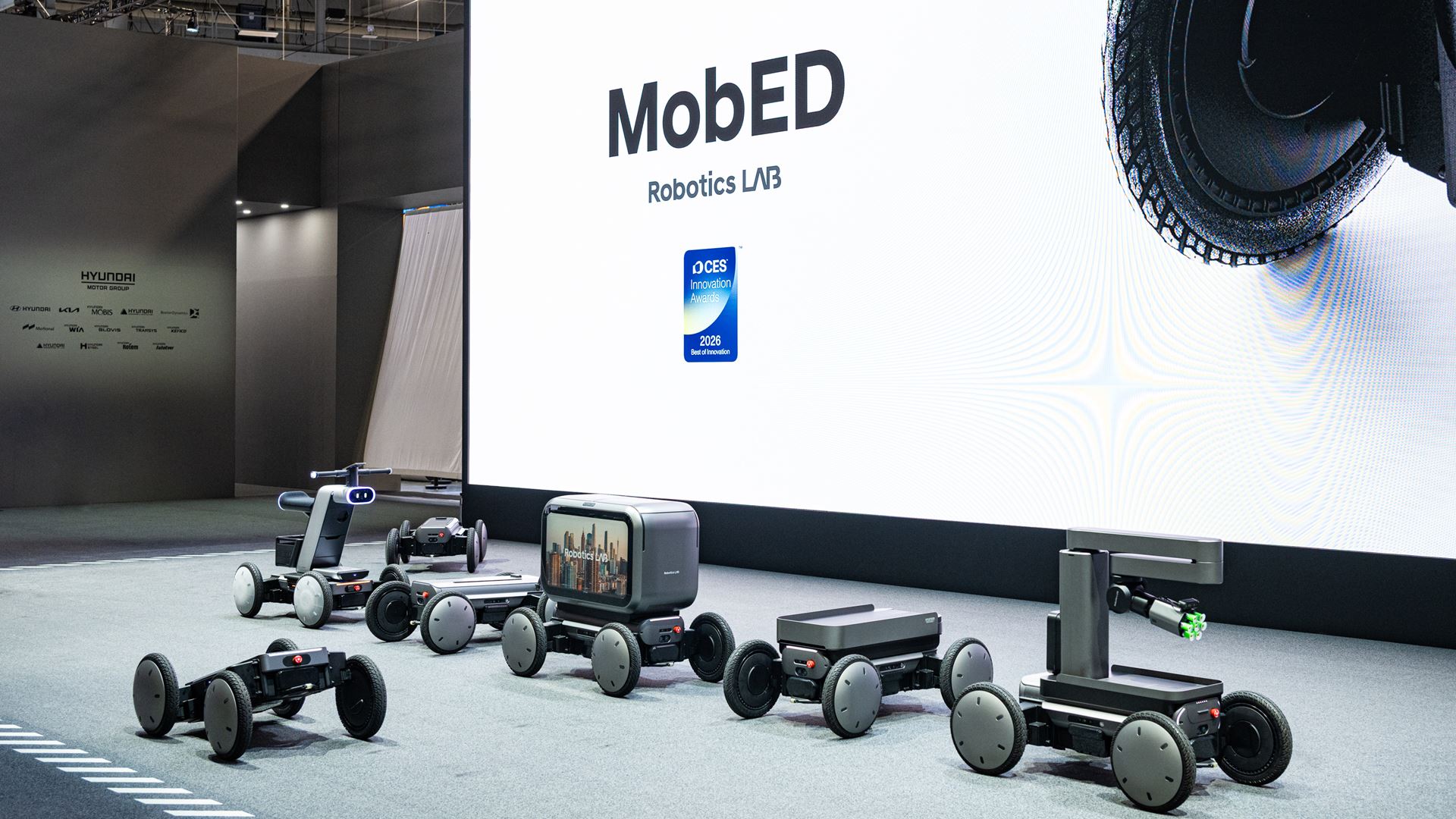
- Hyundai Motor Group presents practical scenarios for using AI robotics in daily life and work environments, along with the transformative potential of physical AI, through interactive demonstrations and experiences
- The Group hosts hourly technology presentations with detailed explanations to help visitors better understand the showcased innovations
- The exhibition introduces core products and related technologies leading the future AI robotics ecosystem:
- The Atlas prototype and the Atlas product designed for real-world deployment
- Spot integrated with Orbit AI, a dedicated software platform for robotics
- The Group presents a convenient and smart future enabled by AI robotics technology:
- MobED commercial models and concepts combining top modules applicable to various scenarios
- The charging of the IONIQ 5 RoboTaxi using the Automatic Charging Robot and parking the EV6 using a Parking Robot
- The Group showcases AI robotics applications for a safe and efficient working environment:
- Hands-on experiences with X-ble Shoulder and demonstrating the quality inspection process using Spot AI Keeper
- Autonomous logistics environment through demonstrations of Stretch, collaborative robots, and autonomous mobile robots
Hyundai Motor Group (the Group) is showcasing a comprehensive lineup of cutting-edge products and integrated technologies set to spearhead the AI robotics ecosystem at CES 2026 from January 6–9 at the Las Vegas Convention Center (LVCC), West Hall. The Group’s 1,836-square-meter booth features various exhibitions, allowing attendees to directly experience the latest advancements in AI robotics technology.
Notable displays include next-generation robots such as Atlas, Spot, and Mobile Eccentric Droid (MobED), which are demonstrated through scenarios highlighting their practical applications in daily life and work environments. The exhibits focus on showcasing the transformative potential of physical AI through immersive demonstrations and interactive experiences.
Unveiling Core Products and Technologies to Lead the AI Robotics Ecosystem
The Tech Lab zone, designed to replicate an AI robotics research environment, offers visitors the opportunity to experience key innovations expected to shape the future AI robotics ecosystem. These include the Atlas prototype, the Atlas product and demonstrations of Spot powered by Orbit AI solutions.
The Atlas prototype is an early-stage model designed to test core functions required for future products. Featuring joints capable of 360-degree rotation, it enables natural walking and efficient, stable movement, allowing for fully autonomous operation at worksites.
Making its debut at CES 2026, the Atlas product is a culmination of Boston Dynamics' extensive experience. Equipped with autonomous learning capabilities and the flexibility to adapt to any working environment, it is optimized for maximum efficiency in real-world manufacturing settings.
The new model features 56 degrees of freedom (DoF)[1], allowing most joints to rotate fully. It is equipped with tactile sensors in human-sized hands and a 360-degree camera, enabling it to perceive its surroundings in all directions with ease.
Additionally, the robot has the power to lift up to 50 kg (approximately 110 pounds) and can reach a height of 2.3m (about 7.5 feet). It boasts exceptional durability, operating at full capacity in extreme environments ranging from -20°C to 40°C (-4°F to 104°F). It is also waterproof, making it washable as needed.
As an industrial robot, it can perform a wide variety of tasks, from material handling to precision assembly. Remarkably, it can learn most tasks within a single day. Moreover, when the battery runs low, the robot is designed to autonomously move to a charging station, change its battery, and immediately resume operations.
The Group has set the goal of mass-producing the Atlas Prototype to deploy it on a large scale in industrial environments, making it a commercially viable humanoid robot.
At the Tech Lab, visitors can witness a live demonstration of the next-generation electric Atlas research prototype accurately performing sequencing tasks[2].
The exhibition also features Boston Dynamics’ quadruped robot Spot, demonstrating facility management and inspection tasks in industrial environments using Orbit AI.
Orbit AI is a dedicated software platform for Boston Dynamics robots, offering remote control and real-time monitoring, AI-based anomaly detection, and data analysis with insights, enabling efficient robot management and operation.
Physical archives tracing the evolution of Atlas and Spot — from early research models to the present — are also on display.
Enabling a Convenient and Intelligent Daily Life with AI Robotics
At CES 2026, the Group is presenting diverse applications of AI robotics solutions which transform daily life.
Among those on display is the commercialized model of the next-generation mobility robot platform MobED, along with top-module–combined concept models developed for use in various industrial environments such as delivery and logistics. Visitors can also see various driving demonstrations showcasing its autonomous driving technology.
MobED is a compact mobility platform equipped with an innovative wheel drive system. First introduced as a concept at CES 2022, it has evolved into a commercialized model following approximately four years of development, suitable for diverse business and daily environments.
Based on Drive-and-Lift (DnL) modules, MobED features four independently driven wheels and an eccentric[3] posture control mechanism. Each wheel is equipped with three motors that handle driving, steering and eccentric functions, allowing the body to tilt as needed. This enables stable balance on uneven or sloped surfaces and allows MobED to overcome curbs up to 20 cm in height.
A mounting rail on the top of MobED allows various devices to be easily attached depending on usage, while dedicated ports enable top modules to be powered and controlled using the built-in battery and controller.
The commercialized models of MobED are divided into two lineups: Basic and Pro.
The Basic model is designed for research and development purposes to implement autonomous driving robots. It serves as an experimental platform, allowing research institutions or developers who purchase the robot to apply their own custom-developed autonomous driving software as needed.
The Pro model, on the other hand, is an autonomous driving platform equipped with advanced capabilities. It features AI-based algorithms and autonomous driving technologies that integrate LiDAR and camera sensors, enabling it to recognize people and obstacles. The Pro model can safely and efficiently navigate complex and diverse environments, including indoor and outdoor spaces, for tasks such as logistics delivery, filming, and general mobility. Additionally, it includes an intuitive and user-friendly controller, allowing anyone to easily experience and operate its autonomous driving technology.
MobED measures 74 cm in width and 115 cm in length, with a maximum speed of 10 km/hour. It can operate for more than four hours of operation on a single charge and offers a maximum payload capacity ranging from 47 kg to 57 kg, depending on the lineup.
At CES 2026, the Group unveiled five conceptual models combining top modules, including MobED Pick & Place, MobED Delivery, MobED Golf, and MobED Urban Hopper, among others.
The MobED Pick & Place and MobED Delivery models are designed to support efficient delivery and logistics operations. The MobED Golf offers a hands-free, convenient golfing experience, while the MobED Urban Hopper is optimized as a scooter for urban mobility.
Additionally, the Group showcased the IONIQ5 RoboTaxi, developed in collaboration with Motional and based on the IONIQ 5.
The IONIQ 5 RoboTaxi is equipped with autonomous driving technology co-developed by the Group and Motional. It achieves Level 4 autonomy as per the standards of the Society of Automotive Engineers (SAE). Level 4 autonomy means the vehicle's automated system can perceive, make decisions, and drive independently, even handling emergencies without requiring driver intervention.
The IONIQ 5 RoboTaxi, Motional's first fully driverless commercial autonomous vehicle, is set to officially launch its ride-hailing service for the general public in Las Vegas, USA, starting this year.
At the exhibition, the Group is demonstrating the process of charging the IONIQ 5 RoboTaxi using its Automatic Charging Robot (ACR), as well as parking a Kia EV6 in a tight space using Hyundai WIA's Parking Robot, capturing the attention of visitors.
The ACR features an IP65-rated waterproof and dustproof design, enabling it to operate in harsh weather conditions such as rain or snow, and in temperatures ranging from -20°C to 50°C (-4°F to 122°F). This ensures stable electric vehicle charging services even at outdoor charging stations.
Hyundai WIA's Parking Robot is an intelligent parking system capable of moving vehicles weighing up to 3.4 tons. With its ability to control over 100 robots simultaneously, the system maximizes space utilization not only in urban parking environments but also in industrial settings.
A Safer and More Efficient Workplace Enabled by AI Robotics Technology
The Group is also highlighting how AI robotics technology is being directly applied to industrial sites to create safer and more efficient working environments.
Visitors are given the opportunity to try on the industrial wearable robot, X-ble Shoulder, in an exhibition zone replicating assembly and inspection processes from manufacturing sites. For the demonstration, attendees can experience an overhead task simulation for the E-GMP platform.
The X-ble Shoulder, developed with proprietary technology from the Group’s Robotics LAB and currently in mass production, supports workers' shoulder strength during overhead tasks. By reducing musculoskeletal strain, it minimizes the risk of worker injury, decreases fatigue, and improves productivity.
The standout feature of the X-ble Shoulder is its design, which generates torque without requiring power. This makes it lightweight and eliminates the need for charging, resulting in easy maintenance and management.
Additionally, it incorporates a muscle compensation module that provides support, reducing the load on workers' shoulder joints by up to 60% and decreasing anterior and lateral deltoid activation by up to 30%.
Furthermore, the AI Keeper, based on Boston Dynamics' Spot, demonstrated its ability to collaborate with workers to perform precise assembly and inspection tasks.
The AI Keeper is an intelligent quality inspection solution where Spot autonomously detects assembly defects on an automotive production line. Based on the inspection results, it enables immediate corrective actions. This automates the assembly quality inspection process and allows precise checks even for hard-to-reach internal vehicle components.
In addition, Boston Dynamics' Stretch, a logistics loading and unloading robot, along with Hyundai WIA's Collaborative Robot (Cobot) and Autonomous Mobile Robot (AMR), are being showcased in a logistics demonstration involving loading, transportation, and unloading tasks. These demonstrations highlight the creation of a modern, automated logistics and manufacturing environment.
The intelligent logistics robot Stretch uses advanced AI to automatically detect and unload goods, ensuring stable operations even in diverse container and trailer environments. Designed for quick deployment, it enables efficient and continuous logistics operations. Currently, global clients such as DHL and Gap are utilizing this robot in their operations.
Cobot is an industrial robot designed to safely collaborate with humans in the same workspace. It features six-axis joints, allowing free movement in three-dimensional space and the ability to learn work paths. It can perform a wide range of tasks, from palletizing to precision processes such as assembly, packaging, and inspection.
Meanwhile, AMR is based on Simultaneous Localization and Mapping (SLAM) technology, utilizing LiDAR sensors and 3D depth cameras. It independently recognizes its surroundings and obstacles to select optimal travel paths, enhancing the efficiency of logistics operations. The AMR is currently being used across the entire manufacturing process at Hyundai Motor Group Metaplant America (HMGMA).
Meanwhile, the Group is hosting hourly technology presentations at its booth, featuring real-time demonstrations and in-depth explanations of its Atlas, Spot, and MobED robots. Notably, the performances by Spot and MobED are receiving significant praise and enthusiasm from attendees.
[1] "Degrees of Freedom" refers to the number of independent variables in a system that can move or change.
[2] Refers to the action of picking up parts from one shelf and sorting them onto another shelf.
[3] A structure where a fixed bar is attached to a position offset from the center of the disc (wheel). Notable examples include steam engines and bicycle wheels.