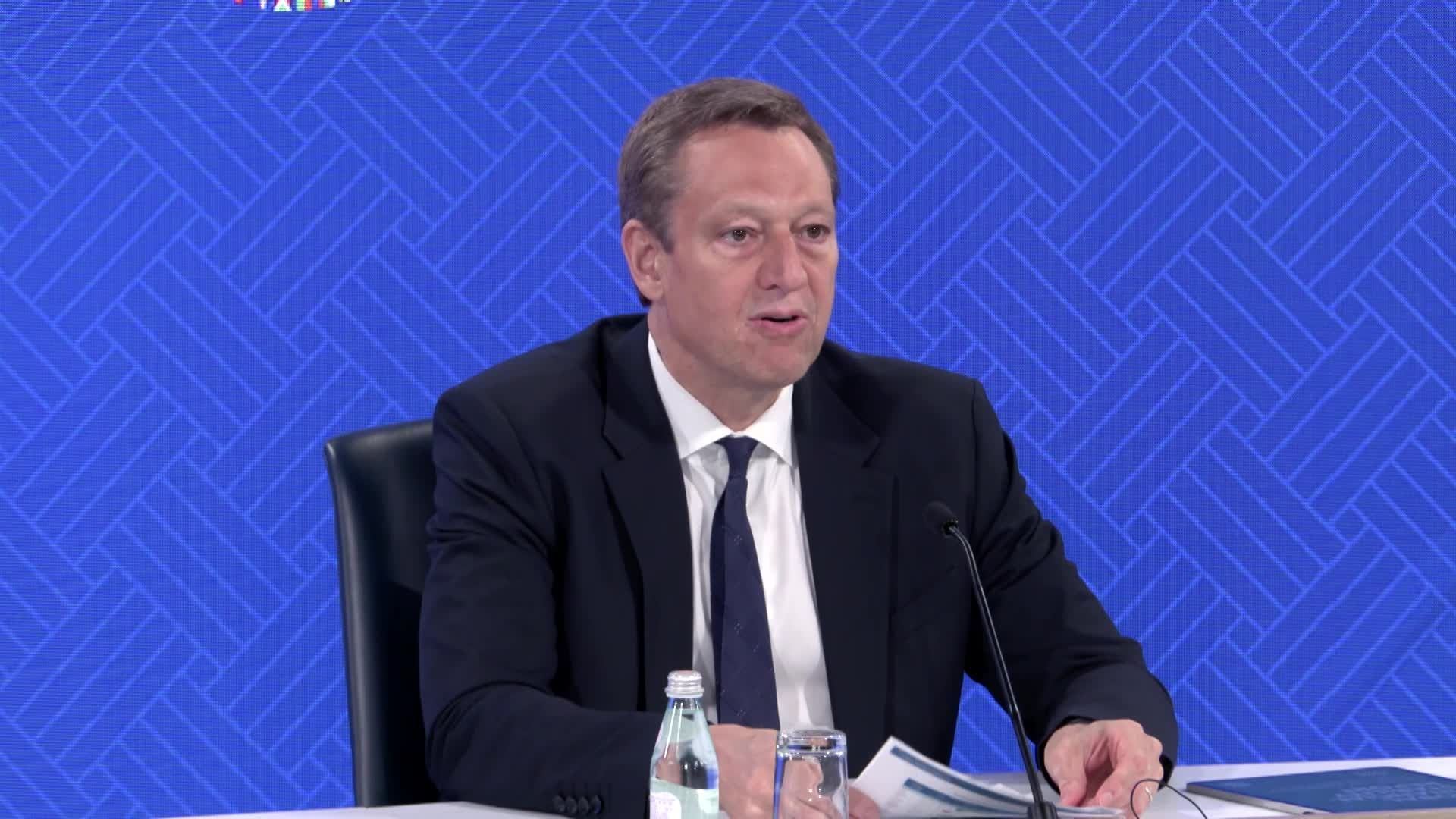
Financial markets have remained broadly stable despite ongoing geopolitical tensions, according to the Global Financial Stability Report presented at the International Monetary Fund’s 2026 Spring Meetings. Tobias Adrian, Financial Counselor and Director of the Monetary and Capital Markets Department, outlined how resilience has held up so far – and where underlying vulnerabilities could still pose risks.
“Markets have been functioning in an orderly manner. Central banks have been supporting markets in a number of countries, through liquidity facilities. And of course, there have also been, structural improvements in markets, for example, through central clearing. We also see the benefits of resilient banks, which remain well capitalized and liquid. So, the banking system is not a worry at this point, at this particular juncture. Now, having said all that, the resilience is not assured in all states of the world. And let me go into some of the vulnerabilities: elevated public debt and private debt, rollover risk, as well as the bank sovereign nexus continue to make bond markets fragile - at least in some countries. And, we particularly focus on the presence of leveraged investors in these markets. So, as governments have issued more debt, a lot of nonbanks have stepped in,” said Adrian.
Attention also turns to other areas where leverage and interconnectedness could heighten risk, including private credit and technology-related investments. In emerging markets, a growing reliance on nonbank financing introduces additional exposure to shifts in global risk appetite. These dynamics add to the set of vulnerabilities that require close monitoring.
“When we think back over the past 5 or 6 years, oftentimes, governments have come in to support financial stability with the policy space. But the policy space has been drawn down in many countries. So, against this backdrop, it is very important for countries to safeguard financial stability by monitoring closely how vulnerabilities are evolving, taking macro prudential actions where necessary, having strong oversight of the banks and the nonbanks, and of course, being operationally ready to inject liquidity,” advised Adrian.
With more limited policy space, the focus shifts toward preparedness and vigilance rather than anticipating specific shocks. The emphasis is on understanding where risks are building and ensuring that responses can be deployed if conditions deteriorate.
“It's very hard to know what shocks are going to come down, but rather to ensure that vulnerabilities are contained, are understood and that actions can be taken if there are any instabilities that arise. Finally, let me underline that artificial intelligence represents both opportunities and risks. And one of the risks that we are highlighting is the cybersecurity risk in this area. So that needs to be managed carefully, and the appropriate policy steps need to be taken there as well,” cautioned Adrian.
To watch the full press briefing, click here: Press Briefing: Global Financial Stability Report
To read the full report, click here: Global Financial Stability Report