
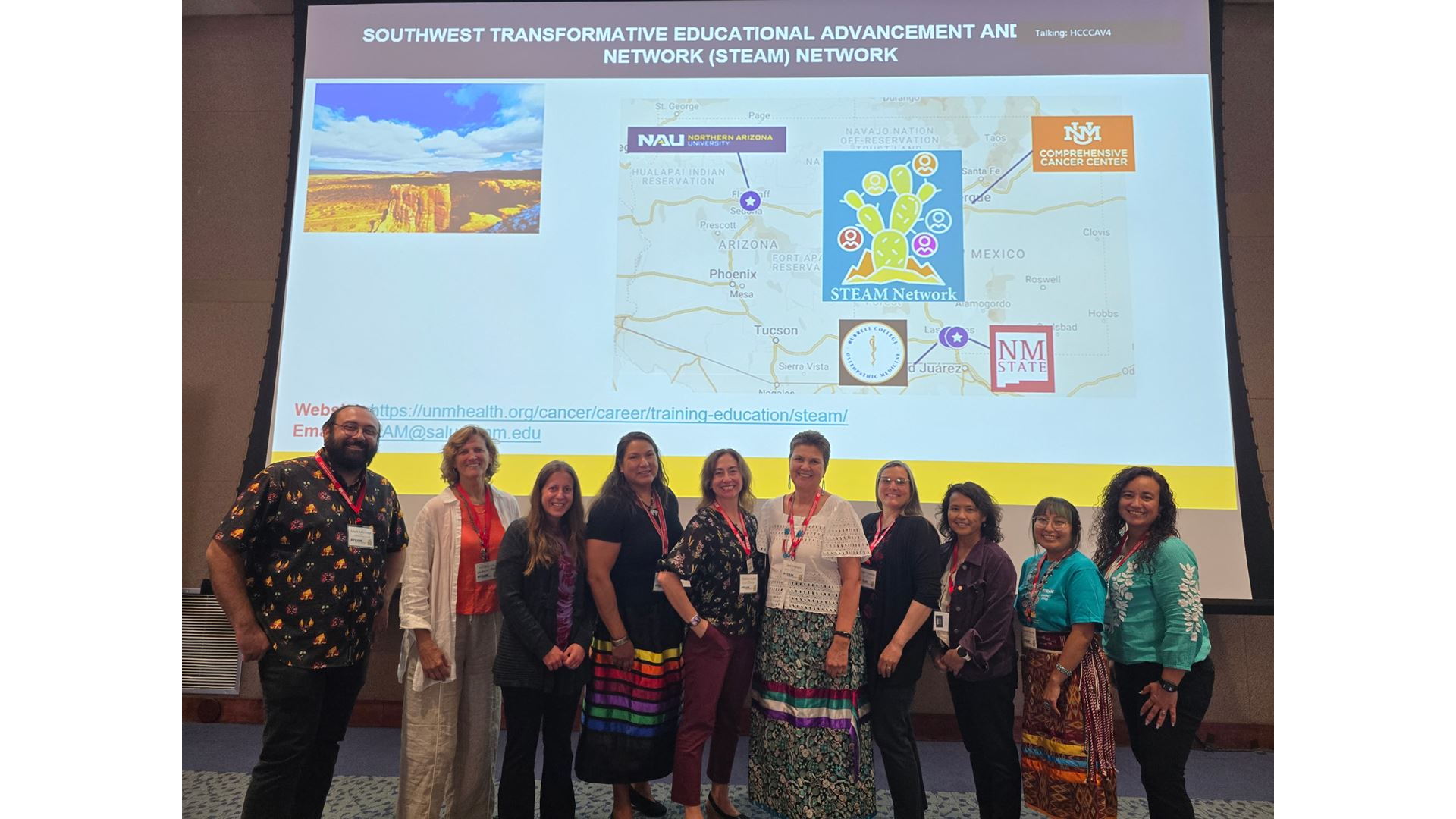
Scientists pursuing a career in research or medicine often find themselves following educational and other opportunities across the country. For many students from the Southwest region of the United States, this means leaving home. A National Cancer Institute (NCI) grant from the National Institutes of Health (NIH) is building a support network for cancer researchers in the Southwest, helping early-career cancer researchers stay in the communities they most want to serve.
“We have a lot of students who want to stay here and continue contributing to this area,” said Graciela Unguez, New Mexico State University biology professor and co-principal investigator on the grant. “The challenge was, how do we connect and network people within this area? That was the big push, focusing on professional development and opportunities to grow the network of young scientists.”
The Southwest Transformative Educational Advancement Mentoring (STEAM) program helps support early-career cancer researchers as they advance their training in the region. Led out of the University of New Mexico, the program includes NMSU, the Burrell College of Osteopathic Medicine, Northern Arizona University and the University of Arizona.
STEAM offers career development, mentoring and networking opportunities to any cancer-related researcher at the graduate, post-doctoral or junior faculty level from the participating universities. Scholars have access to resources like travel scholarships, training and funding opportunities, mentorship, annual training summits and professional development webinars – all at no cost.
“We really encourage scholars with any interest in workshops or conferences to reach out to us and we’ll help get them set up,” said Brianna Evans, a marriage and family therapist graduate student at NMSU. She’s also the liaison for young scientists and faculty in the STEAM program.
In her role as liaison, Evans matches scholars with mentors and helps organize professional development and networking events. As a scholar herself, she recently participated in a three-day writing retreat through the program.
“It was really awesome to be there, I was able to hear from scholars from different institutions,” Evans said. “We all spent time working on different projects, we set goals, and it was very productive. It was energizing to see what everyone had accomplished by the end of the retreat.”
For Unguez and co-principal investigator Kristin Gosselink, physiology professor at the Burrell College of Osteopathic Medicine, the writing retreat is one of many benefits provided through STEAM.
“The ability to connect students with mentors in the region and across institutions is a real benefit,” Gosselink said. “This has been an opportunity to engage more students in research without requiring too many additional resources.”
It’s not just the scholars reaping the benefits of STEAM – faculty and their institutions are also exploring the growing connections.
“One thing for me that has been huge is getting to know more about Burrell,” Unguez said. “It is very good for our students and faculty to get to know this campus that is walking distance from ours.
“In making these connections and potential collaborations between faculty, I think we have a lot of directions to grow from here,” Gosselink said.
STEAM is currently in its third year, with the potential to be funded for the full five-year period by the NIH. In the long run, Unguez and Gosselink hope to build training programs, mentoring opportunities and networks that last beyond the grant.
“We have to do more to educate ourselves as faculty across different disciplines about cancer,” Unguez said. “Everything is related to cancer – whether it’s directly, or within one or two degrees.”
“It’s a difficult, yet very important time to mentor young scientists,” Gosselink said. “It’s great for them to see people who have persisted through hard times.”
-30-
CUTLINE: A National Institute of Health grant funds a professional development program for early-career cancer researchers in the Southwest. New Mexico State University biology professor Graciela Unguez and Burrell College of Osteopathic Medicine physiology professor Kristin Gosselink are co-principal investigators. Researchers gathered for the yearly STEAM summit, from left: Mark Montoya, Rebecca Matte, Elizabeth Yates Jimenez, Naomi Lee, Dolores Guest, Jani Ingram, Kristin Gosselink, Graciela Unguez, Krystal Charley-Celestino and Martha Martinez Grimes. (Courtesy photo)