
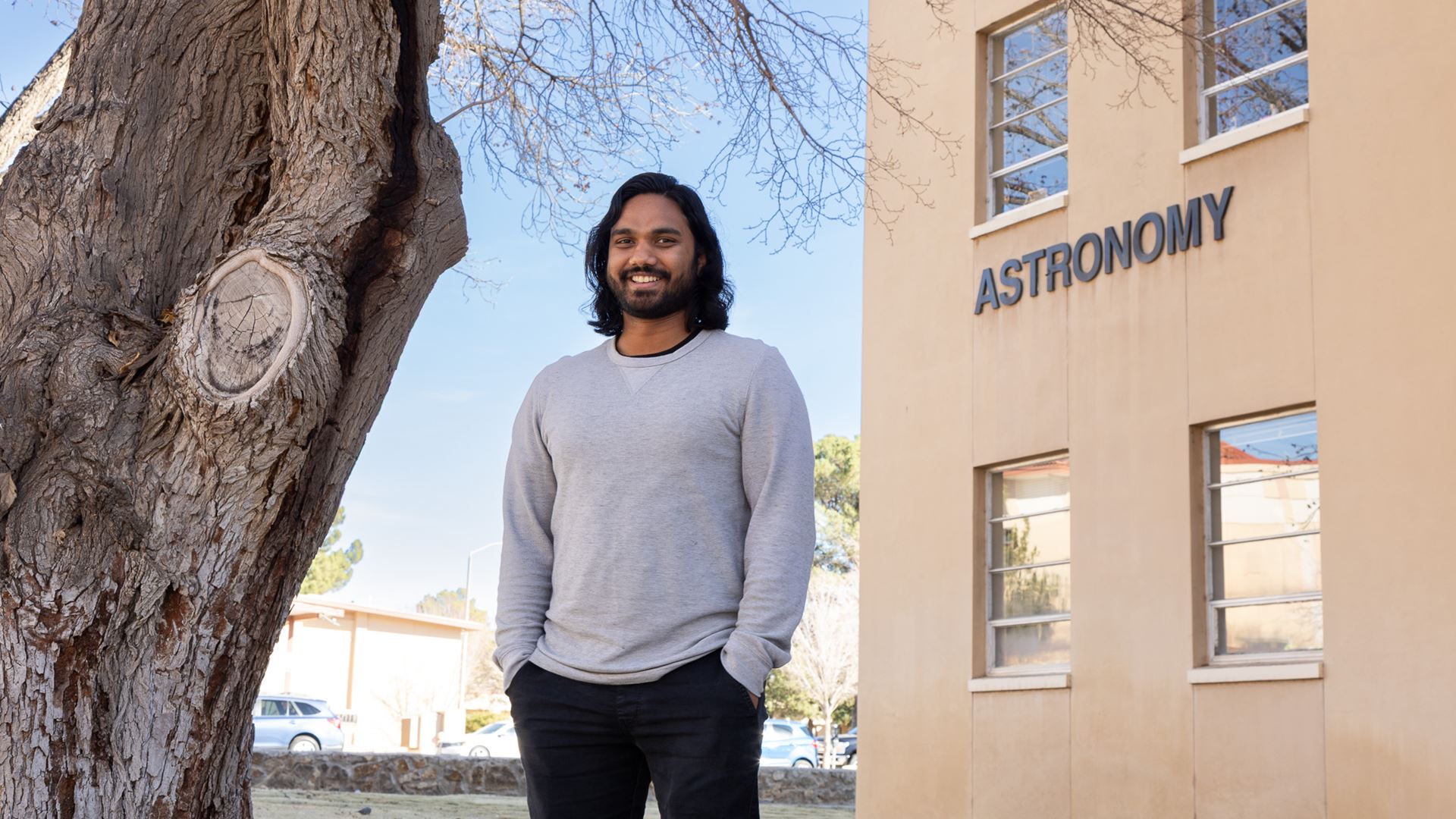
Aman Priyadarshi Kumar, New Mexico State University astronomy Ph.D. student, didn’t start his graduate studies with solar flares, but he’s always been interested in them. When NMSU Astronomy Assistant Professor Juie Shetye asked him to lead a data cataloging project, that interest led them to notice small, compact brightening areas on the sun that preceded nearby solar flares. Today, Kumar’s paper, “Compact Ca II K brightenings precede solar flares: A Dunn Solar Telescope Pilot Study,” was published in The Astrophysical Journal Letters, the third-most impactful scientific journal in astronomy.
The chromosphere is a dynamic layer of the sun that is home to flares and other types of solar activity. Astronomers make observations of this layer using a specialized filter, tuned to the wavelength of ionized calcium K (Ca II K) for a more targeted view, and then plot that data into a light curve. A solar flare appears as a peak in that curve.
While working with flare data from the Richard B. Dunn Solar Telescope (DST) operated by NMSU’s astronomy department in Sunspot, New Mexico, Kumar and Shetye noticed what appeared to be extra peaks in the Ca II K light curves. These peaks, which they coined as “brightenings,” occurred between 10 and 45 minutes before the main solar flare.
“That’s exciting because these ‘early-warning’ brightenings could be a signal for an elevated likelihood of a flare, giving operations teams extra minutes of lead time,” Kumar said.
Ground-based instruments like those at DST can observe brightenings, making them an effective method for flagging regions of the sun that may be more likely to erupt into a flare. Kumar’s work identifies brightenings as a precursor to solar flares and outlines a simple data pipeline to catch them. This would allow operators to capitalize on the 10-45 minutes between the brightening and the flare, helping protect infrastructure like satellites, communication and navigation systems against damage from solar flares.
“Aman was thoughtful and methodical,” Shetye said. “He built a workflow we can trust so our results are reproducible and scalable. This paper gives him a strong research identity at the intersection of ground-based solar observations and space-weather relevance.”
“This project taught me what ‘doing science’ really means – building a clean, reproducible pipeline, being honest about ambiguity and turning a weird pattern into a testable result without overselling it,” Kumar said. “It’s a big, early milestone and it’s already helped me connect with people who care about flare triggering and forecasting.”
As a second-year Ph.D. student, this project marks several important firsts for Kumar. In addition to publishing his first paper as lead author, he was selected to give talks about his work at the American Geophysical Union (AGU) 2025 Annual Meeting and the American Astronomical Society 247th Meeting.
Kumar likened his experience presenting at AGU to “being dropped in the deep end, but in a good way.” The conference brought together over 25,000 professionals in Earth and space science to network and share their research. It was there, two days before his presentation, that he found out his paper had been accepted for publication.
“Presenting the work to a room full of serious solar-flare experts was intense, but the conversations afterward were the best part,” he added. “People asked sharp questions, suggested follow-ups, and treated the result as something worth engaging with. It was the first time I felt fully ‘in the arena’ as a scientist.”
Next, Kumar plans to expand this pilot sample study to a much larger dataset, strengthen the system’s forecasting abilities, problem-solve through complex cases and push toward an automated data pipeline. His goal is to create a robust “nowcasting” system that warns of imminent solar flares in a way that is actionable and easily understood.
“The tension between the promise of early warning, but with real-world complexity, is also why this is fun,” he said. “It’s both physics and practical engineering, and the sun refuses to be boring.”
-30-
CUTLINE: Aman Priyadarshi Kumar, New Mexico State University astronomy Ph.D. student, links brightening regions on the sun to early warnings for solar flares in his paper published today in the Astrophysical Journal Letters. (NMSU photo by Sarah Kimmerly)
CUTLINE: Aman Priyadarshi Kumar, New Mexico State University astronomy Ph.D. student, presents his findings at the American Geophysical Union 2025 Annual Meeting in December. (NMSU photo by Sarah Kimmerly)
CUTLINE: Aman Priyadarshi Kumar, New Mexico State University astronomy Ph.D. student, highlights brightening regions on the sun that precede solar flares in his research. The left panel identifies four regions of interest, or ROIs, on the sun that correspond to a quiet region, a flare, a brightening and another area for further study. The panels on the right show the Ca II K light curves for the flare and the brightening, illustrating how brightenings peak before the main solar flare. (Image courtesy of Aman Priyadarshi Kumar)