
With continuing drought and changing temperatures, wildfires have increasingly become a threat throughout the southwestern United States, especially in rural, mountainous and underserved communities.
Two professors in New Mexico State University’s College of Engineering, however, have come up with a potential solution that would provide much-needed assistance to areas without dedicated wildfire lookout staff, advanced detection systems or robust grid operation centers.
Di Shi, associate professor in the Klipsch School of Electrical and Computer Engineering and Paul W. and Valerie Klipsch Distinguished Professor, and Fengyu Wang, also assistant professor in the Klipsch School of Electrical and Computer Engineering as well as the PNM Utility Management Endowed Chair and associate director of the Electric Utility Management Program, developed Grid Sentinel, a low-cost option that provides artificial intelligence wildfire detection and grid readiness.
“We have been doing AI research for a long time, and the trend is to use very large, expensive and energy-consuming GPUs (graphics processing units) at a very high cost,” Shi said. “Wildfires are also becoming a major problem for forests, infrastructure, etc., especially the communities near these areas. Our idea was to target a different approach and develop a low-cost AI, palm-sized system at a very, very low cost.”
The system Shi and Wang have developed includes cameras and can analyze video and image streams using little energy consumption, which allows the deployment of several devices throughout a location.
“This will work like a safety net for our infrastructure and communities. It can detect wildfire within the first few seconds or minutes of when they occur so that people can take action, and for the infrastructure and power grid to take action.”
Grid Sentinel allows those in charge of an area’s infrastructure to shut down the grid near a wildfire, protecting other communities within the grid from any loss of power.
“It’ll work with a microgrid controller, so that it can trigger control actions and a small portion of the grid can be isolated from the membrane and keep the lights on,” Shi said. “It sends an alert to power system operations and the forestry department about where and when there are fires happening.”
Shi also said he hopes the system he and Wang developed will help protect New Mexico and other southwestern states from some of the devastating effects of wildfires. Their goal is for Grid Sentinel to become commercially available, a rarity for a device based on academic research.
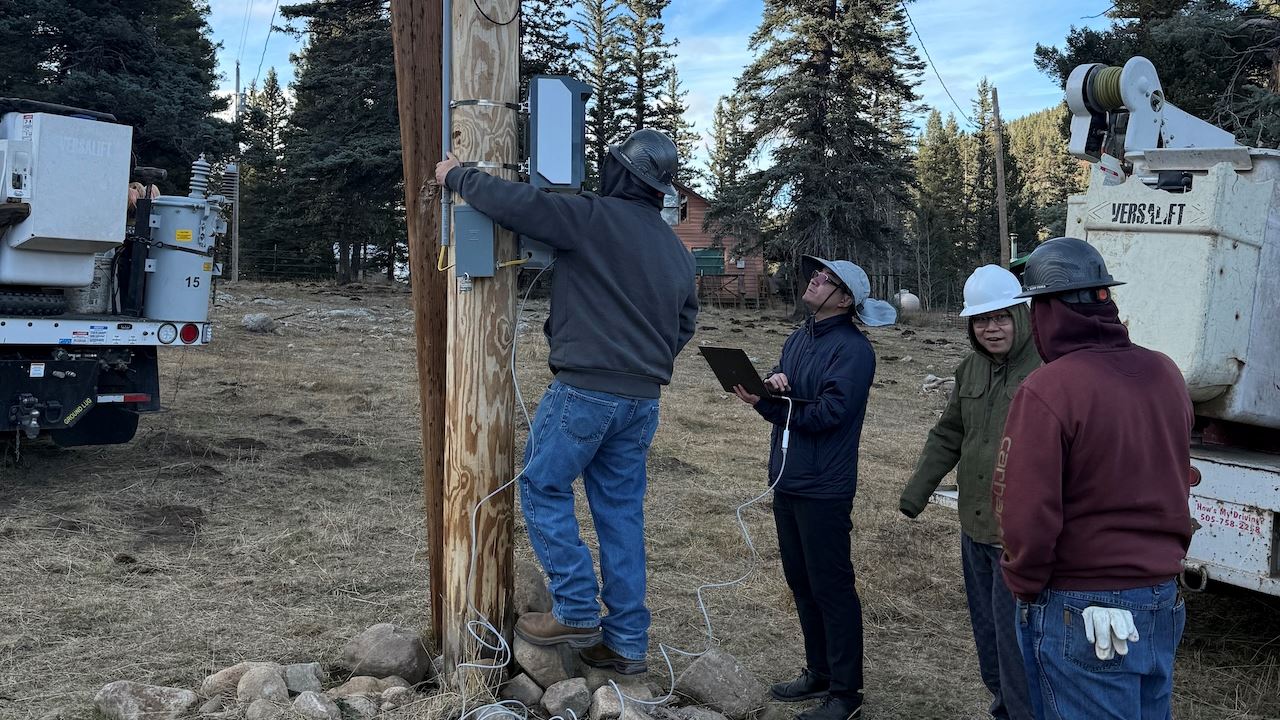
Recently, Shi and Wang worked in the Carson National Forest with a team from the Kit Carson Electric Cooperative to install three units in wildfire-prone areas.
“Wildfire is the most significant risk KCEC faces, as well as one of the most significant risks for utilities across New Mexico and other states such as California,” Wang said. “This low-cost, scalable system provides tangible value to the communities they serve, aligning with NMSU’s land-grant commitment to community resilience.”
There are plans to deploy additional units this month, and leverage the data generated to advance digital-twin research for resilient energy operations. There are also plans to offer the technology to other utility companies and forestry services.
-30-
PHOTO CAPTION: New Mexico State University College of Engineering Assistant Professors Fengyu Wang, left, and Di Shi work on installing a Grid Sentinel system, a low-cost option that provides artificial intelligence wildfire detection and grid readiness, in Carson National Forest with a team from the Kit Carson Electric Cooperative. (Courtesy photo)
IMAGE DESCRIPTION: Two men working on a device indoors.
PHOTO CAPTION: New Mexico State University College of Engineering Assistant Professors Fengyu Wang and Di Shi developed the Grid Sentinel system, a low-cost option that provides artificial intelligence wildfire detection and grid readiness. The system has been installed in Carson National Forest with assistance from a team from the Kit Carson Electric Cooperative. (Courtesy photo)
IMAGE DESCRIPTION: Four men installing a device on a wooden pole.
PHOTO CAPTION: New Mexico State University College of Engineering Assistant Professors Fengyu Wang and Di Shi developed the Grid Sentinel system, which can analyze video and image streams using little energy consumption, allowing for the deployment of multiple devices throughout a location. (Courtesy photo)
IMAGE DESCRIPTION: Image of a computer screen.