
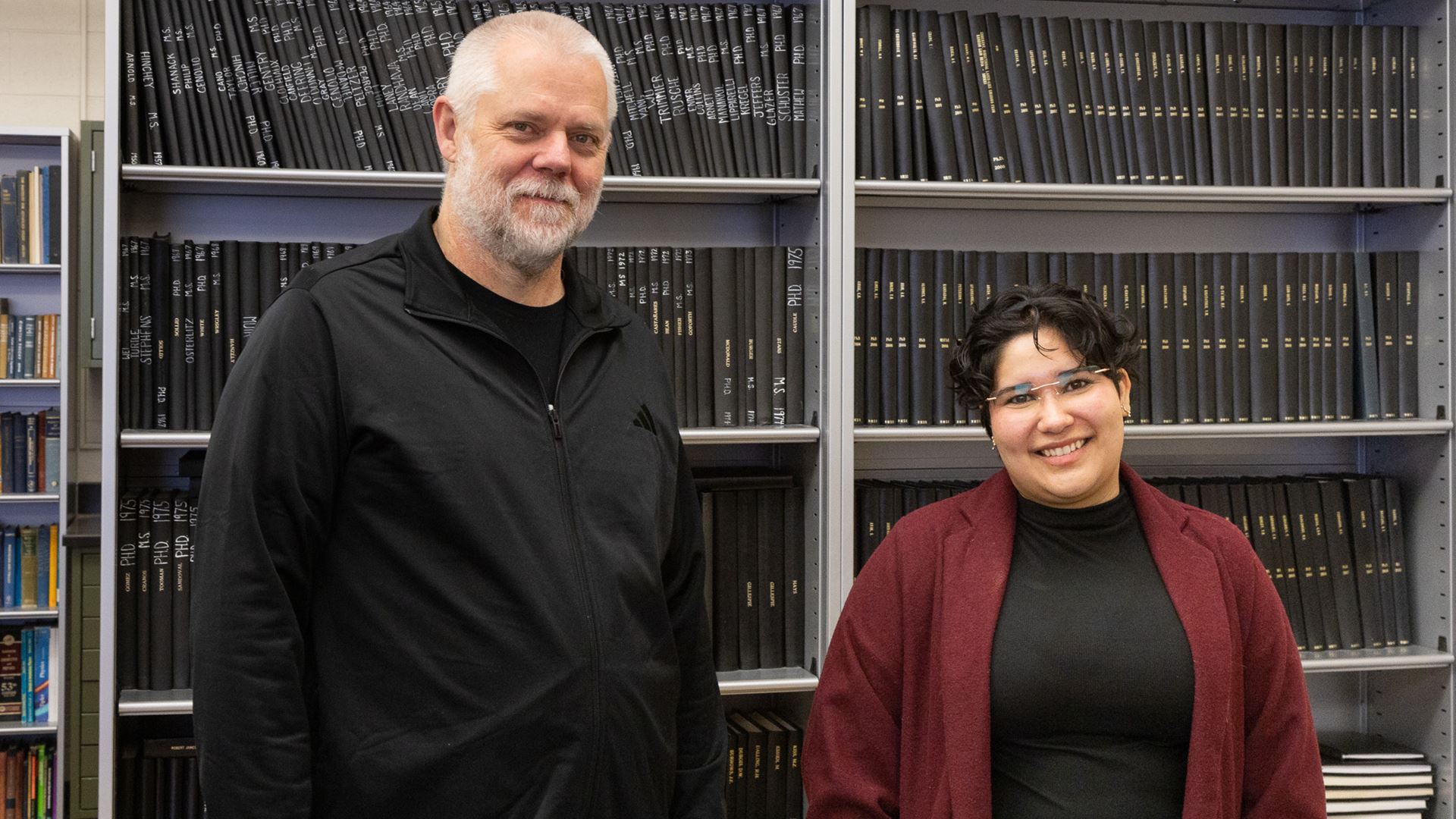
Boris Kiefer, New Mexico State University physics professor, is a co-principal investigator on a project to turn fundamental quantum science into practical technologies that could potentially enable new kinds of computing for certain problems and reduce the high energy costs associated with other quantum hardware systems.
The project led by the University of New Mexico is called “Quantum Computing Applications of Photonics (QCAP).” It is among four selected by the National Science Foundation National Quantum Virtual Laboratory (NSF NQVL) to receive a two-year, $4 million grant.
“The QCAP has tremendous potential,” Kiefer said. “I’m happy we were selected and that I’m part of a team that wants to make these transformations. Hopefully we get to a place where New Mexico can make a real difference in the quantum field.”
“This project will lead to innovation and the advancement of technology, which I am thrilled to be a part of,” said Melissa Coronado Arrieta, a physics master’s student working with Kiefer. “It has the potential to completely revolutionize computing as we know it and I’m excited to witness it.”
The collaboration brings together universities, national laboratories and the private sector. In addition to NMSU and UNM, the quantum photonics group includes the University of Virginia and the University of Maryland, with additional technical expertise from Sandia National Laboratories, Los Alamos National Laboratory and National Institute of Standards and Technology. Together, they’ll use the design phase of the program to define requirements for the quantum computing system, validate key components and map out ideas and targets for early applications of this technology.
“Because of the strangeness of the quantum rules, we might be able to do certain types of problems faster than with any classical computer,” said Kiefer, who is also one of two theoreticians on the project. “We’re talking about transformational changes. It is a fascinating journey to think about what light can do.”
Coronado Arrieta is working to bridge the algorithms and hardware on the project. She connects computing needs to engineering specifications, helping identify algorithms that can reliably run on QCAP-designed devices.
“My experience working on this project has been challenging, rewarding and exciting,” Coronado Arrieta said. “It pushes me to be better both personally and academically, since the topic is complex and counterintuitive at times. The potential this project has makes me excited for the future of science and my career.”
In many of today’s quantum computing platforms, the processor chip may be small, but the surrounding cryogenic infrastructure is not. Systems based on superconducting qubits, for example, typically operate at millikelvin temperatures inside dilution refrigerators, alongside extensive control and readout hardware.
“In many cryogenic quantum platforms, a large fraction of the operating cost is refrigeration,” Kiefer said. “This is where photons have a significant advantage.”
Because photonic qubits can be generated and manipulated without millikelvin cooling, the project can redirect effort from maintaining extreme cryogenic conditions toward tighter integration, higher stability, and better-performing hardware, while refining the algorithms and control software that run the system.
Beyond computing, photonic quantum technologies can also deliver near-term tools that plug into today’s security infrastructure. One such application is the ability to generate quantum random numbers.
“If you can generate random numbers that are truly unpredictable, it dramatically strengthens security,” Kiefer said.
Quantum random number generation relies on the inherently probabilistic nature of quantum measurements to produce high-quality random numbers. Implementing this capability into current systems could strengthen cryptographic key generation, providing more resilient security for financial transactions, satellite communications and other critical infrastructure.
-30-
CUTLINE: Boris Kiefer, New Mexico State University physics professor, and Melissa Coronado Arrieta, physics master’s student, are working on a Quantum Computing Applications of Photonics project to turn fundamental quantum science into practical technologies. The project, led out of the University of New Mexico, was selected by the National Science Foundation National Quantum Virtual Laboratory to receive a two-year, $4 million grant. (NMSU photo by Sarah Kimmerly)