
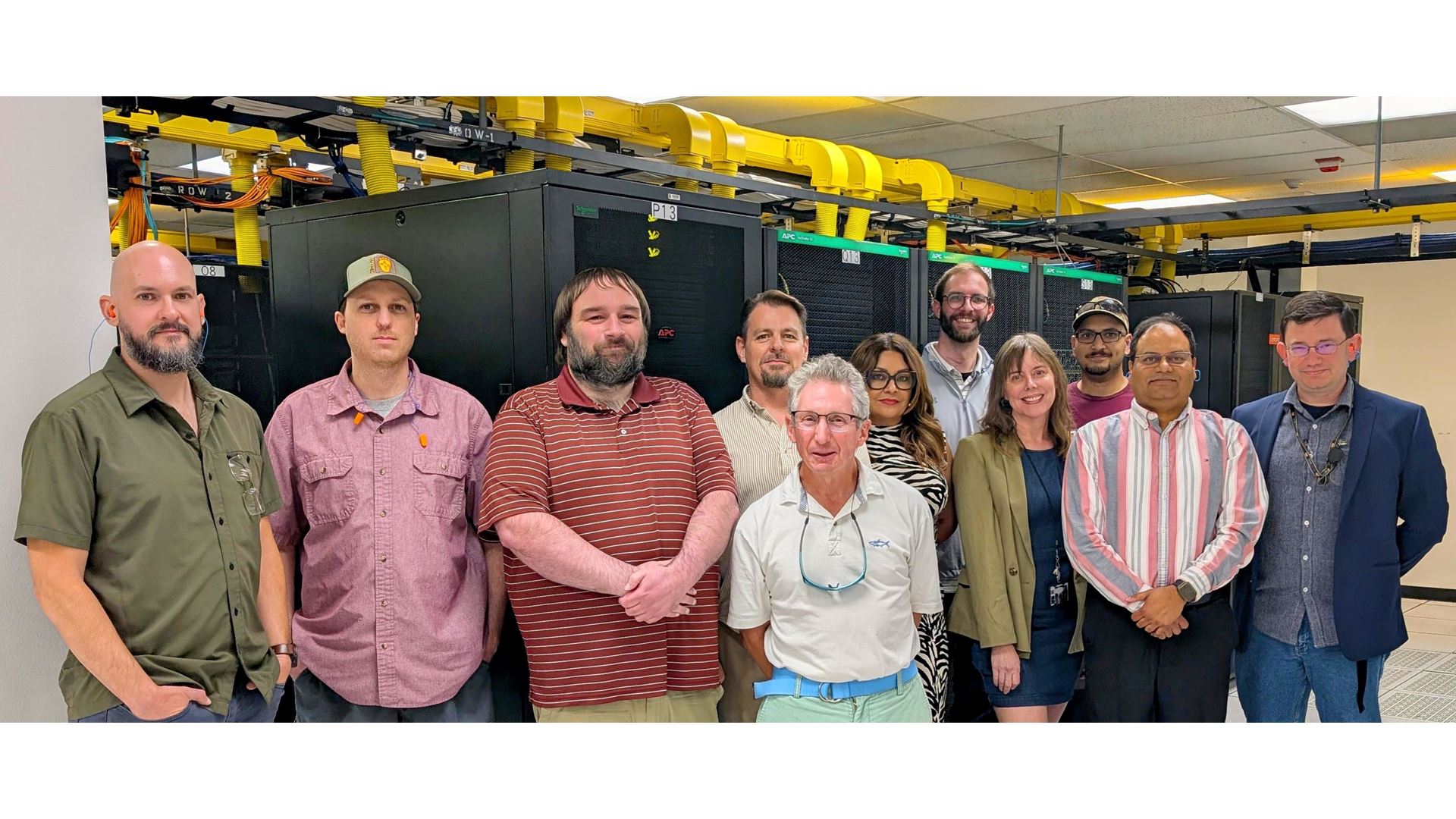
PHOTO CAPTION: The team at New Mexico State University responsible for bringing Colibrí, a high-performance computer system, to the main campus. Colibrí allows researchers to create artificial intelligence models of systems to be tested before implementing those procedures in the real world. (Courtesy photo) IMAGE DESCRIPTION: Group photo.
New Mexico State University is now home to a new high-performance computing system that significantly expands the university’s capacity for state-of-the-art research computing, including locally controlled artificial intelligence, machine learning and big data.
This summer, the NMSU Research Cores Program commissioned Colibrí, an advanced computing system that provides opportunities for AI and machine learning, advanced modeling, data-intensive research and scientific computing. It will support technology development tied directly to challenges faced by New Mexico, with examples that include wildfire detection and response coordination, a full digital twins of local agricultural systems, high-fidelity modeling of water treatment systems designed for New Mexico waters, and edge decision-support technologies for remote hybrid solar, wind and fuel-cell power systems.
“Colibrí was brought to campus through the dedicated work of a team that includes representatives from a range of NMSU organizations, as well as external volunteers,” said Tanner Schaub, NMSU assistant vice president for research. “The multidisciplinary coordination has been seamless, and it is a privilege to work with people who, week after week, work as a team to do the hard work of building infrastructure that serves our faculty and students. These folks advocate for NMSU researchers through action. I cannot thank them enough”
The arrival of Colibrí represents a major step in a multi-year effort by the Research Cores Program to build an integrated advanced computing environment for researchers across disciplines. Industry and national laboratories can also collaborate with researchers on technologies that can be tested and deployed in real-world settings. A wildfire-monitoring project, for example, may require large-scale model training and analysis of sensor-network data before the resulting algorithms can be deployed closer to the field. A digital twin of a brackish water-treatment system may combine physical modeling, large experimental datasets and AI optimization before informing operation of a real system. Remote energy systems may likewise require models developed on high-performance computing infrastructure and then translated into edge decision-support tools capable of operating where connectivity and power are constrained.
Significant financial support has been provided from across NMSU and from federal sources. The New Mexico IDeA Networks of Biomedical Research Excellence contributed nearly $1 million toward computer hardware supporting the new environment.
“Researchers and students within the New Mexico IDeA Networks of Biomedical Research network, which includes 10 institutions of higher education in the state, will have access to the power of Colibrí,” said Shelley Lusetti, NMSU chemistry professor and director of NM-INBRE. “Our investment allows the expansion of computational tools for biomedical data science research across New Mexico.”
The National Science Foundation also awarded $1.4 million to an RCP project led by Lizely Madrigal, NMSU director of University Technology Solutions and Support, to procure the research data-storage system and support a system administrator.
“This investment strengthens NMSU’s research computing infrastructure and demonstrates what we can accomplish through collaboration across the university,” Madrigal said.
The advent of Colibrí also introduces new collaboration opportunities with national laboratories, universities and technology companies. Among those efforts is NMSU’s developing partnership with Fujitsu corporation, which will bring emerging chip technology to campus this fall, in support of energy-efficient computing and edge technology development.
Together, the investments intend to create more than a single computing resource; they are building an environment in which NMSU researchers can develop cutting-edge computing technologies to address real-world challenges in New Mexico.
For a land-grant university, that capability ultimately extends beyond the campus.
“We want students and researchers at NMSU and New Mexico to collaborate with us in developing solutions addressing critical needs in the state. This will be a resource for New Mexico and focused on solution-oriented problem-solving using advanced computing technologies,” said Amy Wagler, director of research computing and data science for the Research Cores Program.
The system combines high-performance CPU computing with substantial next-generation GPU capability. Colibrí includes eight high-density CPU compute nodes and five GPU nodes equipped with a total of 24 NVIDIA RTX 6000 Blackwell GPUs and eight NVIDIA H200 GPUs. The compute is supported by a 7-petabyte VDURA parallel-file-system data-storage appliance. Together, these resources support both traditional scientific computing and rapidly growing applications in artificial intelligence and machine learning.
Wagler said that with Colibrí now online, NMSU begins the next stage: putting computing power into the hands of researchers and students while continuing to build the expertise, partnerships and infrastructure around it that can make research computing an enduring statewide asset.
Besides Schaub, Madrigal and Wagler, the core working group, colloquially known as the research computing Vision Team, includes:
- Henry Newman, volunteer, high-performance computing luminary and NMSU affiliate scholar.
- Gaurav Panwar, assistant professor, computer science.
- Stephen Moreno, software engineer, Physical Science Laboratory.
- Jay Misra, associate dean for research and professor of computer science and engineering.
- Marcus Krohn, IT manager for the College of Agricultural, Consumer and Environmental Sciences.
- David Montoya, CIO, New Mexico Consortium.
- Strahinja Trekakov, high-performance computing system administrator, New Mexico Consortium.
- John Graham, senior development engineer, San Diego Supercomputer Center.
- Kamalavasan Kamalakkannan, computer scientist, Los Alamos National Laboratory.