
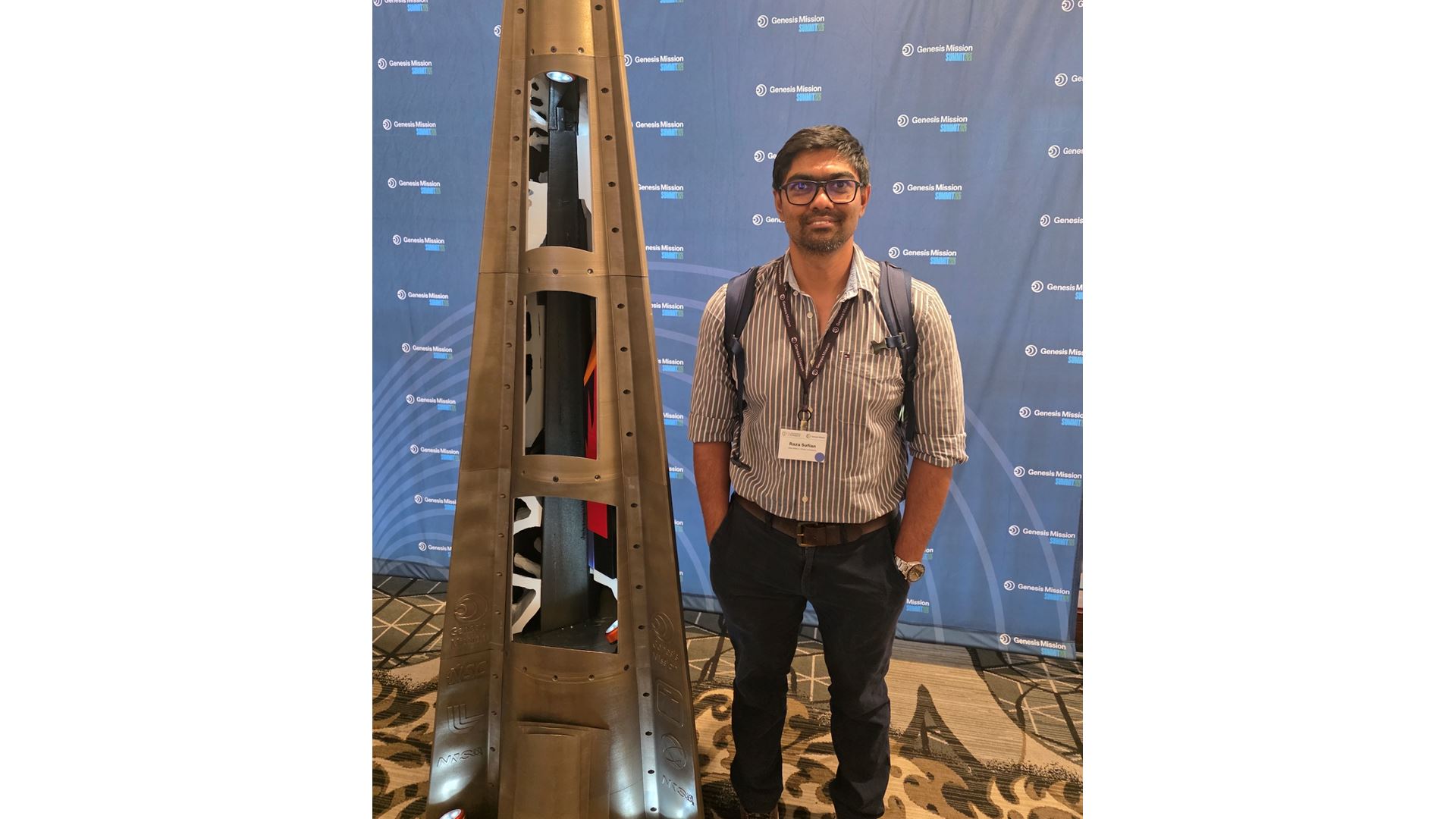
New Mexico State University physics professor Raza Sufian will lead a team of researchers to run a groundbreaking physics simulation on a quantum computer using artificial intelligence.
The team is among those selected for the $800 million Department of Energy program called Genesis Mission, a large-scale initiative of the U.S. government that aims to build the world’s most powerful integrated science discovery platform by connecting supercomputers, quantum systems and artificial intelligence.
The ultimate target is to double America's scientific productivity within a decade. The DOE made the announcement this week at the Genesis Mission Summit in Washington, D.C. The NMSU project is among those funded in Phase I of the program.
“This award is a testament to Dr. Sufian’s scientific leadership and to the world-class research capabilities that continue to grow at New Mexico State University,” said Patricia Sullivan, NMSU interim vice president for research. “His work represents the convergence of artificial intelligence, quantum computing and fundamental physics—areas that are central to the Genesis Mission’s vision for accelerating scientific discovery and technology innovation. Projects like this showcase how NMSU faculty are addressing grand challenges, advancing national research priorities, and contributing to the goals of New Mexico’s Science and Technology Roadmap by strengthening the state's leadership in advanced computing, AI, and emerging technologies that will drive future economic growth and competitiveness.”
In the project, titled “AI-Accelerated Non-Abelian Gauge Dynamics on Quantum Hardware,” Sufian will partner with researchers at the Brookhaven National Laboratory and the University of Maryland over nine months to conduct the first quantum hardware study, using today’s early-stage quantum hardware to demonstrate how to mitigate calculation errors, while creating an artificial intelligence-powered blueprint for fault tolerant quantum computers of the future. Through this effort, the project will take an important step toward answering one of the most fundamental questions in science: how the strong force gives rise to the visible matter that makes up our universe.
“Today's quantum computers are ‘noisy’ and highly prone to calculation errors caused by environmental interference,” Sufian said. “The core idea is to use AI not simply to analyze the results after a quantum calculation, but to help design, optimize, execute and improve the calculation itself. We can think of the AI as an intelligent translator and coach for the quantum computer.”
By training AI models to act as intelligent filters, researchers can study and mitigate hardware noise in real time. This drastically reduces the physical error-correction demands, helping researchers to do meaningful scientific work on today’s imperfect devices.
“First, it translates the physics problem into a compact representation that can be stored on qubits while preserving the essential laws and symmetries of the theory,” Sufian said. “Second, it searches for shorter and more efficient quantum circuits. Third, it adapts those circuits to the connectivity and noise characteristics of the actual quantum processor.
“Finally, it studies the results returned by the hardware and uses that information to improve the next calculation. This creates a closed feedback loop between AI and quantum hardware. Instead of designing a circuit once and hoping it works, the system continuously learns from the device and adapts to its behavior.”
During the first three months, Sufian’s team will develop symmetry-preserving representations of the matter and force fields and construct shallow quantum circuits suitable for real hardware. In the next three months, they will execute the AI-optimized circuits on quantum processors and demonstrate the evolution of a confined quark-antiquark pair and study flux-tube formation, string tension, and the onset of string breaking.
During the final three months, the team will improve the reconstruction of physical observables, test scalability, benchmark the AI-based circuit optimization against standard compilation methods and prepare the results for publication.
For NMSU, the project creates an opportunity to build a visible research program at the intersection of physics, AI, quantum computing and high-performance computing. It will train graduate students and a postdoctoral researcher in a rapidly growing interdisciplinary field and strengthen collaborations not only with Brookhaven National Laboratory and the University of Maryland, but also IBM Quantum and other national quantum-computing efforts.
Genesis Mission couples the U.S. government with a massive consortium of tech companies and 142 universities, including NMSU, that are using machine learning to solve 26 distinct national challenges across energy dominance, national security and discovery science.
The consortium currently includes all 17 DOE National Laboratories, five National Nuclear Security Administration plants and sites, and 41 industry, nonprofit and philanthropic organizations. The DOE is expanding engagement to academic institutions to further strengthen the mission with additional research capacity, capabilities and talent.
“The Genesis Mission is scaling at a pace that reflects not only the strength of its partners, but the shared determination to transform the nation’s scientific enterprise,” said Under Secretary for Science and Genesis Mission Director Darío Gil. “Each new commitment expands our capabilities and accelerates our progress. Together, we are building an innovation engine of unprecedented power, one that only America can deliver.”
Other NMSU faculty and projects funded through Genesis Mission include: David Ruth, assistant physics professor, as part of NMSU’s Experimental High Energy Particle and Nuclear Physics group, is a co-principal investigator on the multi-institutional “Tensor Semi-Inclusive Deep Inelastic Scattering SIDIS Collaboration” partnered with the University of New Hampshire and Thomas Jefferson National Accelerator Facility; and Kenneth C. Carroll, professor of plant and environmental sciences, will be receiving a subaward from the University of Cincinnati. The project is titled, “AI-Enabled Prediction of Coupled Hydrologic and Biogeochemical Processes in Heterogeneous Subsurface Systems.”
-30-
CUTLINE: Raza Sufian, New Mexico State University assistant physics professor, joined researchers from across the country for the Genesis Mission Summit in Washington, D.C. this week. Sufian’s research team was among those selected to receive an award to conduct research as part of massive DOE program that aims to build the world’s most powerful integrated science discovery platform by connecting supercomputers, quantum systems and artificial intelligence. (Photo by Patricia Sullivan)
CUTLINE: From left: Raza Sufian, New Mexico State University assistant physics professor, met Darío Gil, Department of Energy under secretary for science, at the Genesis Mission Summit on July 22. (Photo by Patricia Sullivan)