The National Science Foundation’s Faculty Early Career Development Program (CAREER) is the NSF’s most prestigious award. It recognizes the impact of junior faculty’s success in research and education integration and will fund their quest for five years.
Last month, New Mexico State University astronomy assistant professor Juie Shetye received a 2026 CAREER Award, demonstrating her inspirational leadership for undergraduates and empowering them to become involved in research and pursue advanced degrees. This highly competitive award will run through 2031. Its title is “Hunting Magnetic Fingerprints on the Sun--A Tale of Flare-Jet Connections.”
Shetye’s research on space weather has come up with a prediction algorithm that can warn humans when a solar flare might occur.
This astronomer not only has been studying the sun, but also the faces of undergraduate students, looking for the spark that will draw them into research careers. Shetye’s vision embodies NMSU’s land-grant mission, which has powered her passion since she joined the university in 2020.
For Shetye, the CAREER Award means more than recognition. It provides long-term support for the kind of work she values most: combining solar physics research with student mentoring and community impact. The five-year award will allow her to continue guiding students through research projects from start to finish, giving them time to grow, build confidence and pursue their academic goals. “I love that because it allows me to see their dreams come true,” she said.
The award of nearly $640,000 over the next five years will allow Shetye to fund 20 undergraduate students in addition to four graduate assistants. The undergraduate researchers will be given opportunities to work full-time and be part of a 12-week summer program.
Oana Vesa was the first student who inspired Shetye to build a program involving undergraduate research and community outreach. Vesa, who earned her Ph.D. at NMSU studying solar tornados, is currently a doctoral fellow at Stanford University.
“The essence for me to create a program for undergraduate students stems from my first trial with Oana Vesa, we had a small pocket of money to create the eclipse program,” Shetye said. “This led to getting more students onboard under the first 2024-2025 NSF SHINE (Solar, Heliospheric, and Interplanetary Environment) and NASA MOSAICS (Mentorship and Opportunities in STEM with Academic Institutions for Community Success) cohort. In just one year, they all did wonders and now we are all part of this amazing CAREER journey.”
When two total solar eclipses swept across the United States in October 2023 and April 2024, Shetye gathered two teams, funded by the National Eclipse Ballooning Project and the New Mexico Space Grant Consortium (NMSGC), to study a phenomenon called atmospheric gravity waves, or AGWs, and to engage with local communities about the science behind their research.
In a highly innovative move, Shetye also invited art major Kayla Blundell to join the team to help guide her creative process in making a sculpture to memorialize the solar eclipse research.
Shetye has opened her arms to welcome a broad range of majors across NMSU from astronomy to animation, art to engineering and aerospace to cyber security.
Thanks to Shetye, Rodney Levandosky, an animation major in the Creative Media Institute, is pursuing research about volcanoes. Logan Flowers, a cyber security major, is studying the effects of space weather on satellites. Mariana Navarrete, a physics major, is investigating temperature oscillations occurring at twilight in Las Cruces. Edd Sanchez, a physics major minoring in astronomy, is researching energy moving through the outer layers of the sun, using data from a major solar flare.
Last December, Shetye took eight students to the American Geophysical Union (AGU) annual meeting. With over 25,000 attendees from more than 100 countries, AGU is the largest conference for Earth and space science in the world. It was the first time that undergraduates from the astronomy department were selected to present their research at the international event.
“It’s amazing the joy that I get from being there when my students’ are presenting their research and the satisfaction I get from hearing about their innovative ideas,” Shetye said.
Exposing more undergraduates to the excitement of research is the goal. Shetye recently started teaching a course for undergraduates about the history of solar observations in Southwestern United States. She said two Native American students who may never have considered STEM education previously are now interested.
Shetye credits Michèle Shuster, associate dean for research in the College of Arts and Sciences, with molding critical aspects of her successful NSF proposal.
“Dean Shuster helped me with the educational value of the program, especially why it is so important to bridge the workforce gap and what we can do for New Mexico by engaging our students in research,” Shetye said.
The funding Shetye has remaining from previous grants coupled with the CAREER award will likely allow her to stretch her program to support student research beyond five years.
Shetye grew up in India in a family shaped by farming, small-scale business and the discipline of daily work. In that world, the sun was never abstract. It mattered to crops, seasons, labor, energy and survival.
“That idea resonates deeply with the local Aggie community too,” Shetye said. “Many NMSU students come from ranching families, farming backgrounds, military households, first-generation college pathways or small businesses where work is practical and resources are limited.”
It’s the main reason Shetye feels so strongly about the work she does at NMSU and the land-grant mission.
“I do not come from privilege, and many of our students do not either,” she said. “Universities like NMSU matter because they create an intellectual home for students whose talent may be greater than their access. A land-grant university does more than produce degrees. It takes knowledge seriously in places where people are often overlooked, and it turns education into mobility, confidence and public service.”
-30-
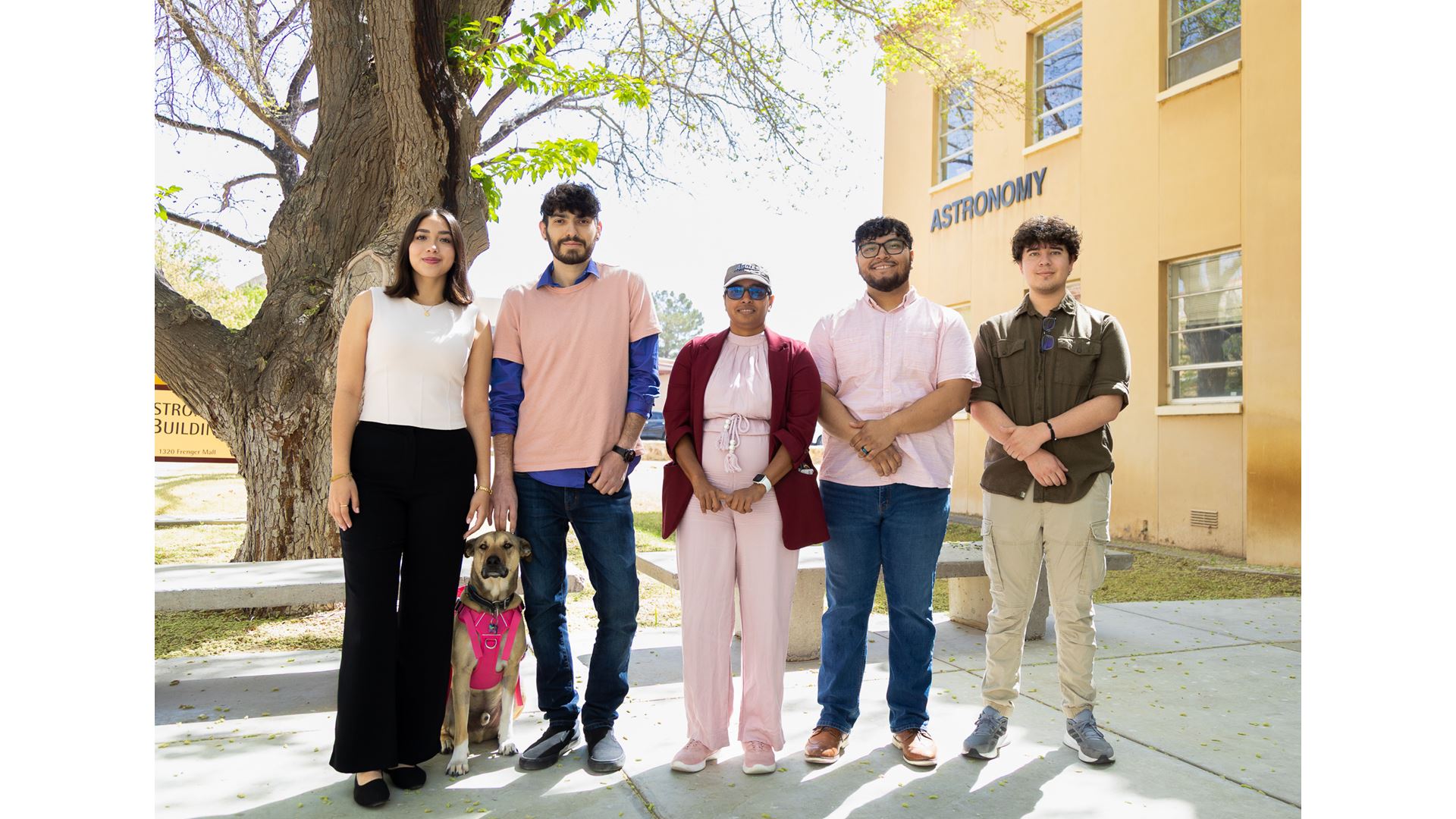
CUTLINE: Juie Shetye, center, New Mexico State University astronomy assistant professor, received a 2026 National Science Foundation CAREER Award. Some members of Shetye’s student research team from left: Mariana Navarrete, (Shetye’s dog Waldo), Rodney Levendosky, Shetye, Edd Sanchez and Logan Flowers. (NMSU photo by Sarah Kimmerly)
CUTLINE: From Left: Oana Vesa, NMSU alumna and current Stanford Post doctoral fellow, inspired astronomy assistant professor Juie Shetye to recruit undergraduates to research careers. (NMSU photo by Josh Bachman)
CUTLINE: Juie Shetye, NMSU astronomy assistant professor, took eight students from her solar research group to present their work at the American Geophysical Union (AGU) annual meeting last December in New Orleans, Louisiana. From top left: Mariana Navarrete, Marcus Guzman, Destiny Hallet, Aman Priyadarshi Kumar, Logan Flowers, Juie Shetye, Subomi Oyewole and Edd Sanchez. (NMSU photo by Sarah Kimmerly)
CUTLINE: Juie Shetye, NMSU astronomy assistant professor, challenged art major Kayla Blundell to weave together astronomy and artwork to create a sculpture of a total solar eclipse. From Left: Photo of finished sculpture, Blundell and Shetye. (Sculpture photo credit: Kayla Blundell/NMSU photo by Josh Bachman)
CUTLINE: Left: NMSU astronomy assistant professor Juie Shetye and her research team at the Agricultural Science Center at Artesia, for the October 2023 annular solar eclipse. Middle: Community members participate in eclipse research. Right: Research group members working with a balloon during the eclipse project. (Courtesy photos)