
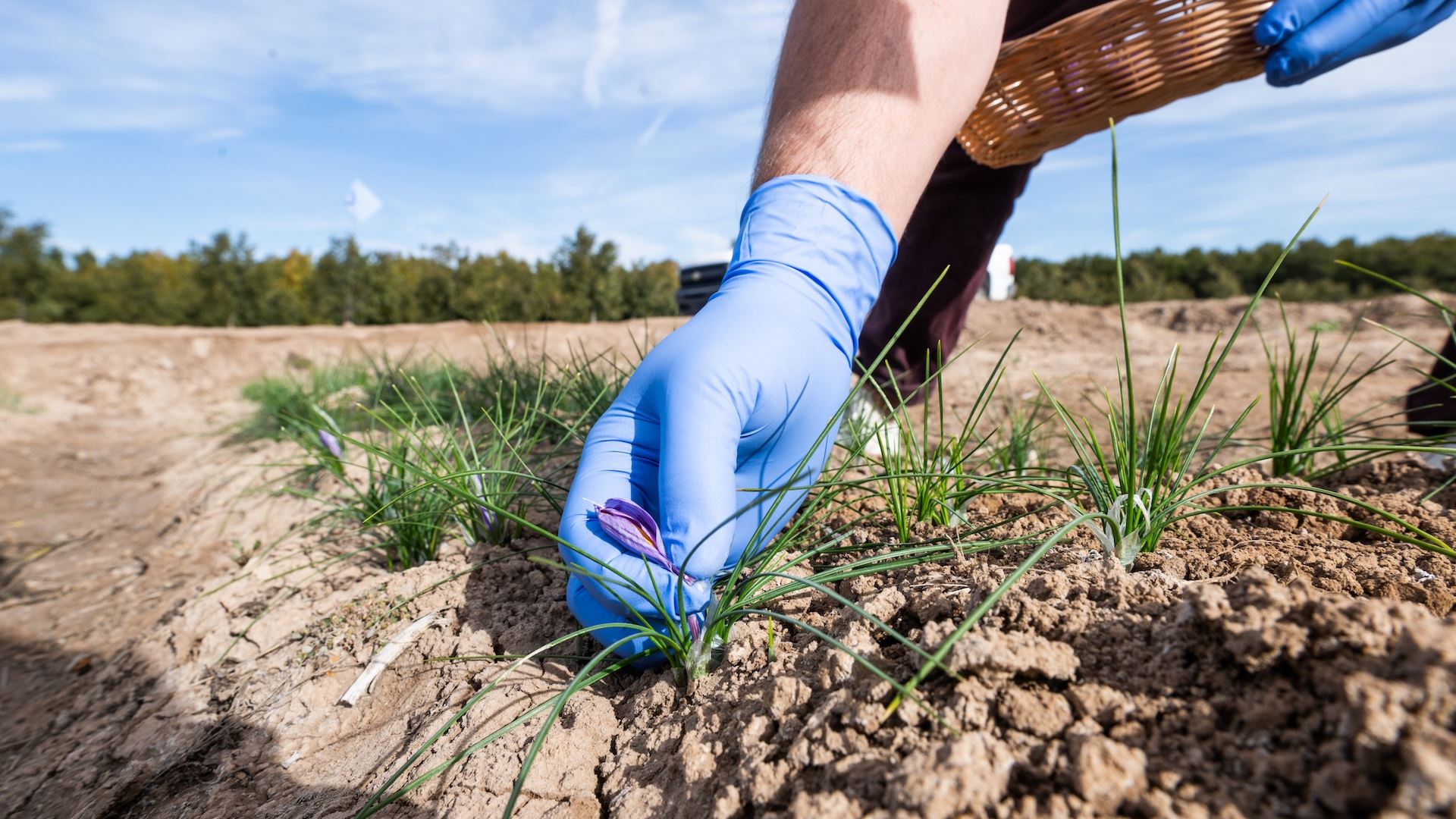
A researcher at New Mexico State University known for his saffron research projects in northern New Mexico is exploring how the crop fares in central and southern parts of the state, as well as how well the crop will grow alongside other New Mexico crops such as chile.
Saeid Zehtab Salmasi, research director of the NMSU Sustainable Agriculture Science Center at Alcalde, recently received funding form the New Mexico Department of Agriculture’s Specialty Crop Block Grant program for a project titled, “Integrating Saffron into Small Vegetable Production Systems of New Mexico to Enhance Profitability and Sustainability.” The project will investigate the intercropping of saffron with chile, and aims to demonstrate the diversification and sustainability benefits of intercropping in New Mexico’s agricultural systems.
Salmasi said one idea he and his research team are exploring is growing saffron in chile fields. His hope is that saffron will thrive during the chile’s dormant season. Saffron is typically harvested in October and into early November. Intercropping saffron with chile could help farmers maximize land use, improve soil health and create new revenue streams.
In 2023, Salmasi began his saffron research in Alcalde by growing the crop in open fields and in hoop houses. He found that the crop did well each season through 2025.
“In some research plots, I have harvested more than six kilograms per hectare, which is really promising,” Salmasi said.
Jay Lillywhite, associate dean and director of the Agricultural Experiment Station at NMSU’s College of Agricultural, Consumer and Environmental Sciences, said Salmasi’s efforts in saffron research is an example of the dedication of all AES researchers.
“Researchers in the Agricultural Experiment Station are dedicated to College of Agricultural, Consumer, and Environmental Sciences’ mission of serving as an engine for economic and community development,” Lillywhite said. “Dr. Salmasi’s efforts exploring saffron as a new value-added crop for New Mexico’s agricultural producers is an example of this dedication. We are excited about Dr. Salmasi’s saffron research and look forward to continuing and expanding the research to further explore the agronomic and economic potential of saffron in New Mexico.”
Saffron is commonly known as the world’s most expensive spice, with an average price of $30 per gram for saffron grown in the United States. That could potentially generate more than $50,000 in net revenue per acre. While the majority of saffron consumed in the U.S. is imported, domestic saffron production has seen increased interest over the past several years.
Lillywhite said Salmasi’s project is an important component of AES research that explores opportunities for new value-added agricultural products in New Mexico.
To discover how saffron would grow in central and southern New Mexico, corms were planted at the Los Lunas Agricultural Science Center in Los Lunas and the Leyendecker Plant Science Research Center in La Mesa in 2025.
“This is the first time we planted them in central and southern New Mexico, and we need some more time to see how saffron performs,” Salmasi said.
In addition to the saffron stigmas, the saffron plant has a wide variety of uses, including medicinal and cosmetic. It contains components known for their beneficial effects on Alzheimer’s, Parkinson’s, depression and other diseases, and can also promote fat reduction, blood sugar regulation and anti-inflammatory diseases.
Saffron is commonly grown in Iran, India, Afghanistan, Greece, Morocco, Spain and Italy. In the U.S. market, wholesale prices can range from $500 to $5,000 a pound, depending on the product grade.
Salmasi decided to explore saffron as a way to give farmers an option to diversify their operations and increase cash flow in the face of a changing climate. Traditional crops have become less lucrative, leaving farmers scrambling to find more profitable options.
Most of the interest in domestic saffron production stems from potential economic returns, with reports suggesting that gross revenues can be as high as $100,000 and acre. In comparison, the New Mexico Department of Agriculture reported that in 2024, the value of New Mexico’s chile production was estimated at $52.2 million from 8,000 harvested acres, suggesting a value of $6,520 per acre. Similarly, New Mexico’s pecan production was estimated at $167.1 million, with 49,000 harvested acres, suggesting a value per acre of $3,409 per acre.
One important factor when considering saffron, Lillywhite said, is that saffron harvesting is much more labor-intensive compared to other crops. It takes about an hour to harvest one gram of dry saffron.
“Certainly, high-gross revenues are enticing, but additional work needs to be done to better understand saffron’s potential in New Mexico,” Lillywhite said.
-30-
PHOTO CAPTION: Saffron grown at New Mexico State University’s Leyendecker Plant Science Research Center in La Mesa is harvested. A project headed by NMSU research Saeid Zehtab Salmasi is exploring how the expensive spice can become the state’s new cash crop. (NMSU photo by Josh Bachman)
IMAGE DESCRIPTION: A hand picking small purple saffron flowers from a field.
PHOTO CAPTION: Saffron harvested at New Mexico State University’s Leyendecker Plant Science Research Center in La Mesa fills a basket. New research suggests that saffron may be successfully grown in certain parts of New Mexico. (NMSU photo by Josh Bachman)
IMAGE DESCRIPTION: A basket filled with purple flowers.