
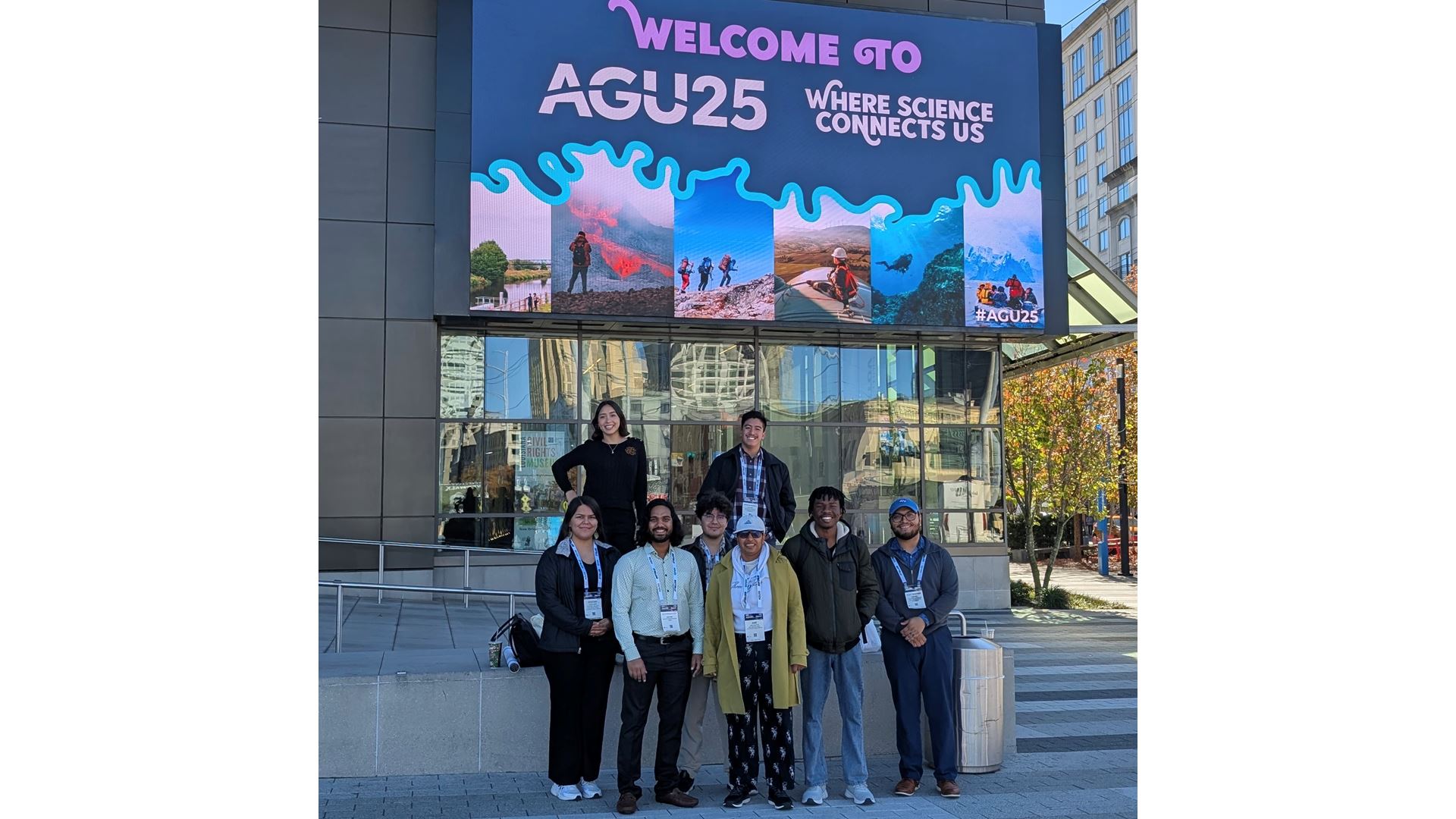
Eight students from a solar physics research group led by Juie Shetye, New Mexico State University astronomy assistant professor, were selected to present their work at the American Geophysical Union (AGU) annual meeting last December in New Orleans, Louisiana.
“I believe this is a landmark moment for our department,” Shetye said. “To the best of our knowledge, this is the first time that a team of undergraduate students from the Department of Astronomy have been selected to present their work at AGU.”
With over 25,000 attendees from more than 100 countries, AGU is the largest conference for Earth and space science in the world. It brings together scientists, educators, students, policymakers, journalists and communicators to share their research and network. Every student in Shetye’s group that submitted an abstract to the conference was selected, with seven students presenting a poster and one student giving an oral presentation.
“Their selections are important because it shows that their research has been peer-reviewed and selected by scientists,” Shetye said. “I am very happy with my cohort that is making wonders.”
Shetye has recruited NMSU students across a broad range of disciplines to join her research group, including everything from astronomy and animation to computer science and aerospace engineering. The students selected to bring their multidisciplinary perspectives to AGU were Logan Flowers, Marcus Guzman, Destiny Hallet, Aman Priyadarshi Kumar, Rodney Levendosky, Mariana Navarrete, Subomi Oyewole and Eduardo Sanchez.
After they arrived in New Orleans, these students seized the opportunity to explore thousands of research posters, attend keynote speeches and oral presentations, browse through the exhibition hall and network with fellow scientists.
“I was able to connect with what being a scientist actually means and how I can build a space for myself within the community,” said Navarrete, a sophomore studying physics and minoring in astronomy. “The most important thing I learned is that science is built through teamwork rather than working alone.”
“My favorite part was the presidential forums,” said Guzman, a senior majoring in aerospace engineering and minoring in astronomy and math. “The conversations were motivational and invited people to advocate for causes they believe in. I also enjoyed the exhibition hall, where I networked with graduate schools to further my education.”
In addition to a full schedule of talks and events, each student had their own presentation to prepare for.
Kumar, a second-year astronomy Ph.D. student, gave a 10-minute oral presentation on his research linking brightening regions on the sun to early warnings for solar flares. He found out two days before his talk that his work had been accepted for publication in The Astrophysical Journal Letters.
“I learned a lot about how to communicate science effectively, especially how to frame results so their relevance is clear,” Kumar said. “It was a big confidence boost navigating a large conference and talking openly about both what we know and what we’re still figuring out.”
Flowers, Guzman, Navarrete and Oyewole gave their presentations during the first poster session of the conference. Flowers, a sophomore studying cyber security, and Guzman are both working on projects studying the effects of space weather on satellites. Navarrete investigates temperature oscillations occurring at twilight in Las Cruces and Oyewole, a first-year computer science Ph.D. student, is developing a method that uses machine learning to automatically study magnetic bright points on the sun, helping scientists better predict solar activity and its effects on Earth-based systems.
“I was able to get good feedback and critiques from some seasoned scientists,” Oyewole said. “At first it was overwhelming and tiring, as it was my first ever conference, but as the days went on, I started to appreciate attending sessions that pertained to my research, learning new and improved techniques that scientists are using and some methods I need or should consider in my current work.”
Sanchez, a senior studying physics and minoring in astronomy, and Hallet, a senior studying physics, presented their posters later in the week. Sanchez studies energy moving through the outer layers of the sun, using data on a major solar flare captured by the Richard B. Dunn Solar Telescope operated by the NMSU astronomy department in Sunspot, New Mexico. Hallet’s work focuses on calibrating instruments and measurements to more accurately describe atmospheric conditions.
Levendosky, a senior studying animation and visual effects, was also selected for a poster presentation, but was unable to travel for the conference. He uses a new method called twilight photometry to study the evolution of volcanic plumes and how they affect the surrounding atmosphere, incorporating animation techniques into his image processing workflow.
Getting selected for and presenting at AGU was an important first for most students in the group. Shetye helped organized their schedules to take full advantage of the learning and networking opportunities provided by the massive gathering.
-30-
CUTLINE: Eight students from a solar research group led by Juie Shetye, New Mexico State University astronomy assistant professor, were selected to present at the American Geophysical Union’s Fall Meeting this December in New Orleans. From top left: Mariana Navarrete, Marcus Guzman, Destiny Hallet, Aman Priyadarshi Kumar, Logan Flowers, Juie Shetye, Subomi Oyewole and Eduardo Sanchez. (NMSU photo by Sarah Kimmerly)