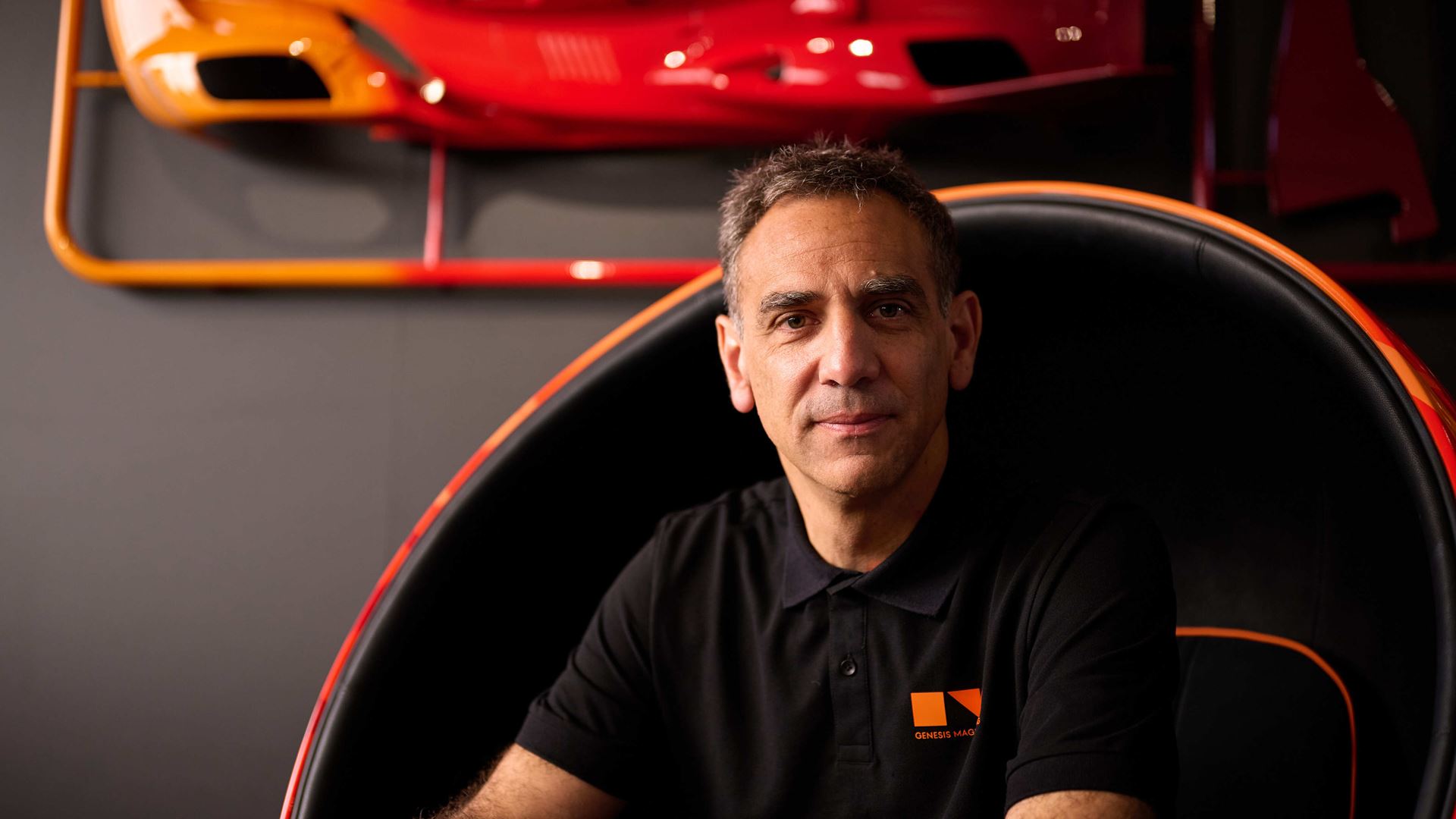
- Cyril Abiteboul looks back on a remarkable 2025 for Genesis Magma Racing as the team has developed both the GMR-001 Hypercar and the team to run it
- The Genesis Magma Racing Team Principal, who has been central to the process, remarks on the particular challenges presented by creating a brand-new team
- He assesses the successful Trajectory Program, engine and chassis development while also looking ahead to the first tests and targets ahead in 2026
Le Castellet, France, 19 December 2025: In the year since Genesis Magma Racing was launched in Dubai in December 2024, the team has been incredibly busy. Over the last twelve months an entirely new team has been created, with staff and drivers recruited from across the motorsport spectrum. The team took its first racing steps as part of the Trajectory Program with the European Le Mans Series, while building and developing the GMR-001 Hypercar it will take into next year’s FIA World Endurance Championship. Reflecting on all the work that has been done, but also that which remains, Team Principal Cyril Abiteboul looks back on 2025.
Can you sum up how 2025 has been for Genesis Magma Racing?
“It's been a positive, busy and constructive year, in which we have not only delivered a great looking sportscar but also built a racing team and established a team base that will be crucial in preparing ourselves over the winter. So, in all these areas, it's been busy, it's been productive, but also very rewarding to orchestrate so much change in just one year.”
What has been the most difficult part about building a team from scratch?
“Building up a group of people is tricky, especially as we were creating a brand-new team in a new location. We had to find the people we wanted to bring in, but most of them were busy doing something else, so we had to give them the prospect of not just what we are now, but what we can become together by explaining what the project is about and getting them to believe in the project.”
“The other big challenge was clearly on the powertrain side. We had very limited time to design the specific parts needed to adapt our WRC engine to the specific requirements of endurance racing to create the Genesis G8MR 3.2l Turbo V8. It was clearly a race against the clock. Everything happened very quickly, but we've been able to comply exactly with the schedule we set, from the very first crankshaft revolutions in the dyno in February, to, last week, hitting the 8,000-kilometre target that we had set ourselves.”
How essential do you think the Trajectory Program and our partnership with IDEC Sport have been in preparing the Genesis Magma Racing team?
“It was a good tool for us to get to know endurance racing and for endurance racing to get to know us. The ELMS season was also a great opportunity to assess drivers, and that certainly influenced our decisions about our lineup next year. It was also an opportunity for some team members to build a transition from rally into circuit racing.”
“On track it was very positive. Usually, I'm a big fan of setting targets, but coming to ELMS, actually we had few sporting targets. Then, when success started to come, for sure, it was a great feeling and it began to draw more attention externally and internally, which was precisely the objective. I remember already after race one in Barcelona when we had the first win, I received lots of messages, almost surprised at what we could already achieve. With IDEC Sport, we clearly did well with three wins out of six races, but you still always want a bit more, so we were all a little frustrated of the final championship outcome, but again, it was never the main target for this season.”
Can you summarise the on-track development we have done with the car?
“From shakedown onwards, it was a succession of tests with clear plans and targets, and an action plan between each session. It's been busy, but it's been very structured. Our approach was ambitious and pragmatic at the same time – focused on problem resolution and we've done exactly that. What's been great is the number of things that were right straight out of the box. The chassis in particular. The behaviour of the car and the reaction to setup change were immediately very good. ORECA gave us a very sound platform from which to build reliability and performance. There has been a good level of cooperation between us and ORECA, from the first test where Genesis Magma Racing staff were clearly outnumbered by ORECA but then came a tipping point as our team was growing. The transfer of responsibility took place very professionally, another demonstration of the very strong planning and execution this year by the team management, Chief Engineer Justin Taylor and Team Manager Anouck Abadie in particular.”
What was the high point of the year, or a crucial point in the development of the car?
“There were a few points, I think. First, in the test at Circuit Paul Ricard in summer, when the first feedback from André and Pipo about the general behaviour of the car was positive. That was certainly good – there is nothing worse than having to fight for the balance of the car, but the development is far from being linear. We've been making some steps forward, but it's a very, very long process and we know that we are still very far from being able to extract all the lap time that is possible from the package.”
How important of a milestone is the engine passing 8,000 kilometres during the Barcelona test?
“It's a big milestone because it shows that it's possible, that there is nothing fundamentally wrong in the engine and in our development decisions. It's a clear demonstration of the capacity of our powertrain group to deal with very short timelines, but also some challenging early days and issues for which measures were developed successfully, and in time.”
“It's obviously a motivation, because we know we have a product that has the capacity to reach the level we need. Quality control will be essential to make sure that it's not just a one off, but something that we can fully reproduce, and that powertrain technology becomes one of the recognized strengths of Genesis Magma Racing.”
How does what the team has achieved compare to the goals that were set at the start of the year?
“If I look at what we had to deliver, I think we delivered extremely well, but it will always be relative to where the bar is placed by our competitors, and we will only be able to find that out next year. In the GMR-001 Hypercar we have a car that has clearly strong potential. The team is maybe new but filled with individuals with huge amounts of experience in various categories. And finally, our lineup of drivers is a very strong balance of three champions – André Lotterer, Pipo Derani and Mathieu Jaminet, an exciting rising star in Mathys, and very established professional drivers with Paul-Loup and Dani. We have exactly what we need – now it's up to us to make the best out of it.”
What are the next steps for the team and the car development in the first part of 2026?
“There will be more test days before the first race. It's about trying to do as much as we can before the car goes through homologation, because then any changes will be more limited. That's why the start of the year will be extra busy. We need to have many more iterations on the software side, so that will be very much the focus, as well as working on all the procedures that will be critical when the season starts.”
“Our target for the start of the year is for us to have both a car and team – including the drivers – that are reliable, making no mistake, focus on completing the race. If we can do that, then it will be about building competitiveness. Once again, it is all about planning for building the very solid foundations we will need in the years to come.”
About Genesis Motor Europe
Founded in Seoul, Genesis is a leader in premium electrified cars with a vibrant, distinctly Korean spirit.
Launched in Europe in 2021, the brand’s award-winning premium models offer a luxurious ownership experience, defined by advanced technologies, dynamic performance and the trademark ‘Athletic Elegance’ design philosophy. Committed to a more sustainable future, the Genesis lineup in Europe includes GV60, Electrified GV70 and Electrified G80, offering effortless refinement, intelligent features, and unique interior concepts inspired by ‘the beauty of white space’.
Headquartered in Frankfurt, Genesis Motor Europe operates in Germany, Switzerland, and the UK - as part of its ongoing market growth strategy, the brand will launch in France, Italy, Spain, and the Netherlands in 2026. Underlining its position as a design-driven performance brand, Genesis will introduce GV60 Magma, its first high performance model, and debut the Genesis Magma Racing LMDh car in the 2026 World Endurance Championship.
For more information about Genesis, please visit www.genesis.com.