55 Years of the Lamborghini Miura SV
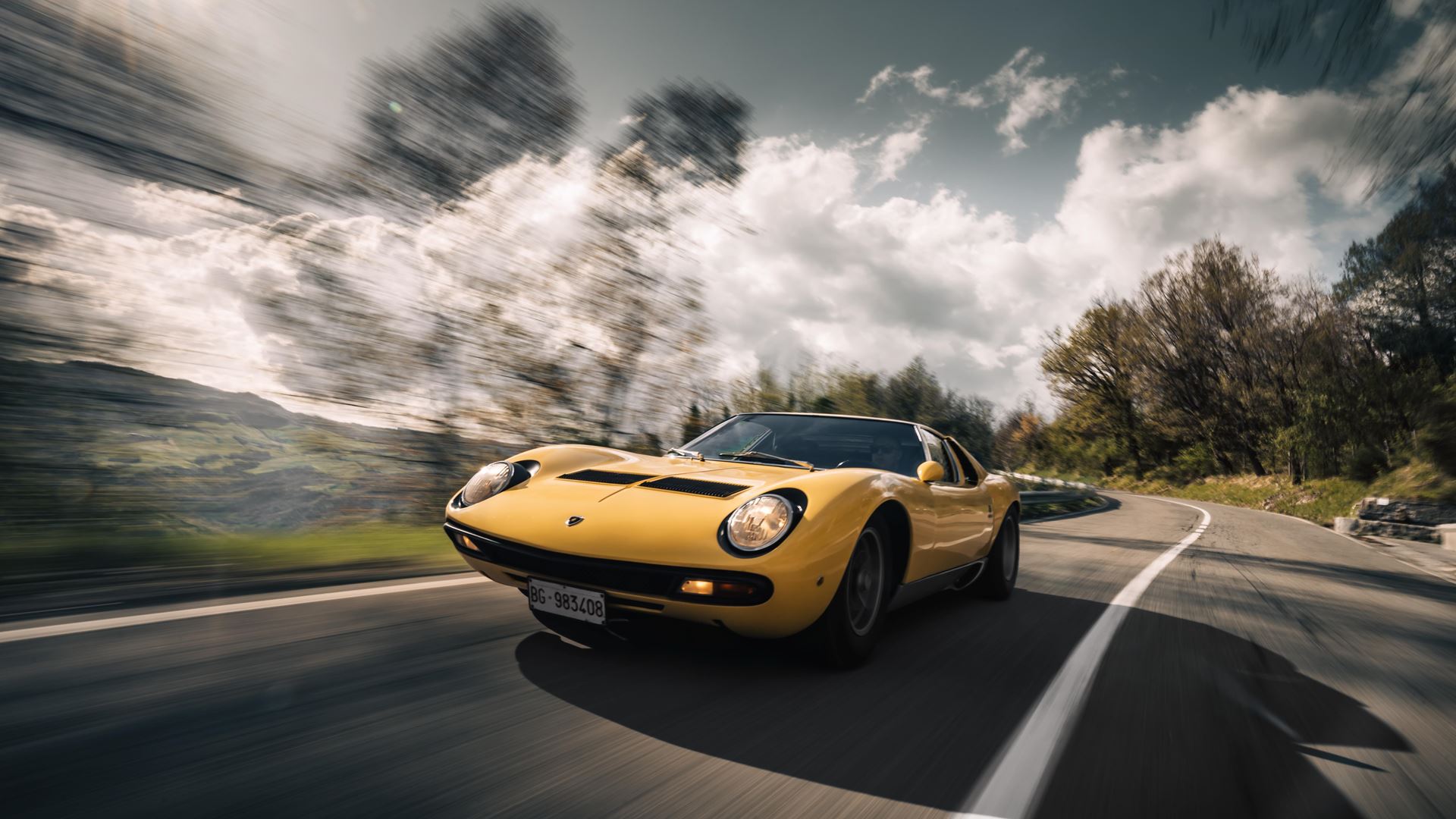
Sant’Agata Bolognese, 28.07.2026 – The Lamborghini Miura SV, which celebrates its 55th anniversary this year, set a new standard in performance cars when it was first introduced in 1971. As the ultimate evolution of the Miura, it established the ‘Super Veloce’ philosophy, a designation that has become synonymous with Lamborghini’s most desired and uncompromising V12 models.
The Miura SV was the last, and most extreme, version of what was already the first “supercar”. Automobili Lamborghini had gained extensive experience with the earlier versions, the Miura P400 (1966), and its successor, the Miura S (1968), and the SV built on the strengths of those original models to become a natural extension of the legend.
The Miura was the first to carry a V12 engine that was transversally mounted ahead of the rear axle. Almost immediately it became an iconic car, one that transformed the sports car world, but then Lamborghini introduced the Miura SV, the final and most exciting version of them all. The Miura SV, which remained in production until 1973, featured upgrades that delivered greater control and everyday practicality.
“With the Miura SV, Lamborghini brought the evolution of the Miura to its ultimate expression and introduced a designation that would become an integral part of the brand’s DNA,” says Stephan Winkelmann, Chairman and CEO of Automobili Lamborghini. “Super Veloce has always represented the purest interpretation of Lamborghini performance: a combination of increased driving emotion, enhanced dynamic capabilities and a distinctive character. From the Miura SV onwards, every SV model has embodied our commitment to continuously pushing the boundaries of performance and driving experience.”
The Miura, both in its P400 and S versions, was spectacular to drive, yet the exciting and demanding handling offered room for optimization in the areas of driving stability at high speeds, and engine lubrication. Lamborghini responded to feedback from its test drivers and customers with a refinement of the original concept.
At the heart of the Miura SV remained the transversely-mounted 3.9-liter V12 engine, but it was developed, resulting in an increased output of 385 hp at 7,850 rpm and 388 Nm of torque at 5,500 rpm. The increased power delivery, combined with numerous chassis and aerodynamic improvements, enhanced both performance and drivability compared to the Miura P400 and Miura S.
The Miura SV accelerated from 0 to 100 km/h in less than 5.5 seconds and reached a top speed of more than 290 km/h, making it one of the fastest production cars of its era and the ultimate expression of the Miura lineage. Building on the benchmark established by the original Miura, the SV further cemented Lamborghini’s position at the forefront of the super sports car segment.
One of the most significant technical changes to the Miura SV, aside from the increase in power, was a change to the lubrication system: While the engine and transmission in the first versions shared a common oil circuit, Lamborghini separated these in the Miura SV. This measure significantly improved the durability and reliability of the engine and transmission and represented a decisive step forward in development.
At the same time, Lamborghini revamped the chassis. The engineers widened the rear track, adjusted the suspension, and tuned the chassis to be stiffer overall without sacrificing ride comfort. As a result, the Miura SV gained noticeable stability, particularly at high speeds, and handled in a more controlled and precise manner. The introduction of ventilated disc brakes, which were powerful by the standards of the time, ensured more stable deceleration.
Externally, the Miura SV was also clearly distinguishable from its predecessors without diluting the elegant and now iconic silhouette. The characteristic “eyelashes” around the headlights were omitted, giving the front a cleaner appearance. Also striking were the significantly widened rear fenders, which made room for larger tires while simultaneously underscored the increased performance. These changes were not purely aesthetic but were directly linked to the improved driving dynamics.
Fifty-five years after its debut, the Miura SV remains the foundation of a philosophy that has defined some of Lamborghini’s most focused and uncompromising V12 models. More than a name, Super Veloce has become an enduring legacy and one of the defining expressions of Lamborghini’s DNA and history.
Lamborghini Miura SV (1971–1973)
Engine: 3.9-liter V12, 385 hp at 7,850 rpm, 388 Nm at 5,500 rpm
Top speed: over 290 kph
0–100 km/h: 5.5 s
Kerb weight: 1,245 kg
Improvements: separate engine and transmission lubrication, wider rear axle for better traction, modified rear suspension, increased power, faster and more controllable, some with limited-slip differential
Special features: final version of the Miura series, no headlight covers, modern appearance, highest power output and road holding in the series
Price: 8,600,000 lire
Company information
Founded in 1963 in Sant’Agata Bolognese, near Bologna, Automobili Lamborghini is one of the world’s leading names in luxury super sports cars, defining the future of the segment through uncompromising performance, design and emotion. Rooted in a 100% Italian identity and supported by a global community driven by passion, craftsmanship and people, the company combines technological innovation with authentic racing DNA, with motorsport serving as both a strategic laboratory and a core expression of the brand.
From iconic models such as the Miura, Countach, Diablo and Aventador to limited editions including the Sesto Elemento and Fenomeno[1], Lamborghini has consistently created lasting value through rarity, personalisation and craftsmanship. Today, its fully hybrid line-up is structured around three main model families: Revuelto[2], the first HPEV with a V12 engine; Urus SE[3], the first plug-in hybrid Super SUV; and Temerario[4], the benchmark V8 HPEV in its category. From each family come the most extreme versions, such as Urus SE Performante[5], an authentic expression of the brand and its most performance-oriented soul.
With over 3,000 employees and a network of 186 dealers in 57 countries, Automobili Lamborghini continues to grow responsibly through long-term vision, innovation and sustainability.
[1] The vehicle is not yet offered for sale and is therefore not subject to Directive 1999/94/EC. The fuel consumption and emissions data is in the type approval stage
[2] Revuelto (WLTP): Energy consumption (weighted combined): 4,7 kWh/100 Km plus 15 l/100km; CO2 emissions (weighted combined): 350 g/km; CO2 class (weighted combined): G; CO2 class with discharged battery: G; Fuel consumption with discharged battery (combined): 17,9 l/100km
[3] Urus SE (WLTP): Energy consumption (weighted combined): 21,4 kWh/100 Km plus 5,71 l/100km; CO2 emissions (weighted combined): 140 g/km; CO2 class (weighted combined): E; CO2 class with discharged battery: G; Fuel consumption with discharged battery (combined): 12,9 l/100km
[4] Temerario (WLTP): Energy consumption (weighted combined): 6,4-4,3 kWh/100 km plus 11,2-10,3 l/100km; CO2 emissions (weighted combined): 272-252 g/km; CO2 class (weighted combined): G; CO2 class with discharged battery: G; Fuel consumption with discharged battery (combined): 14 l/100km
[5] The vehicle is not yet offered for sale and is therefore not subject to Directive 1999/94/EC. The fuel consumption and emissions data is in the type approval stage