
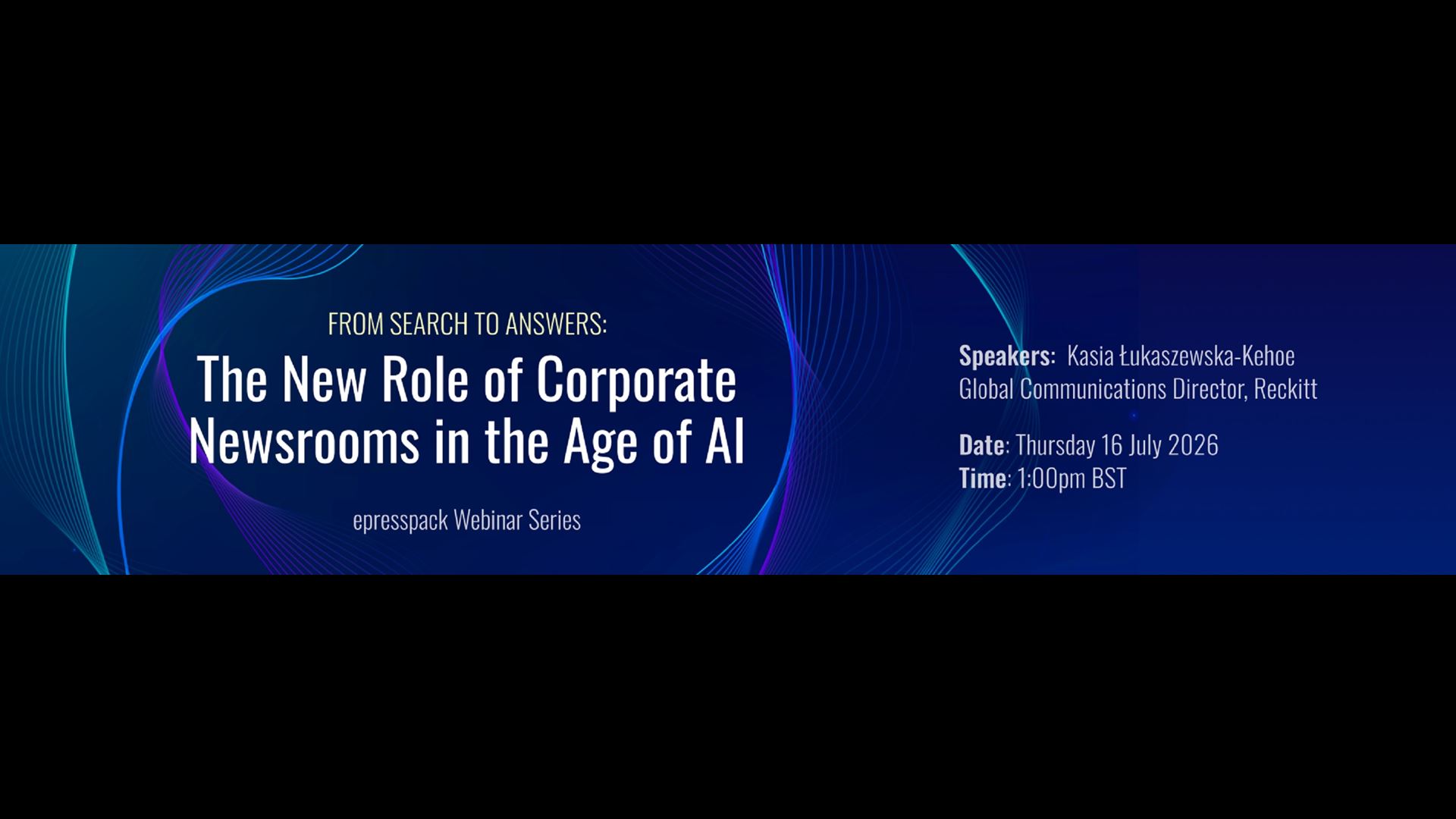
"The first reader of your content is likely to be an AI agent."
That simple observation from Kasia Łukaszewska-Kehoe, Global Communications Director at Reckitt, set the tone for our latest epresspack webinar.
As AI-powered search rapidly changes how people discover information, communications teams are beginning to ask different questions. Rather than focusing solely on media coverage, SEO or social engagement, many are now asking:
How do we ensure our organisation becomes part of AI-generated answers?
Over the course of the discussion, Kasia shared practical insights from Reckitt's own journey, together with her perspective on how corporate communications is evolving.
Here are five key takeaways.
1. AI is changing who your first audience is
For decades, communicators have written primarily for journalists, customers, investors and other stakeholders.
Today, there's another audience to consider.
AI systems are constantly crawling corporate websites and newsrooms, looking for trusted information they can use to answer questions. In many cases, they are now the first reader of corporate content.
That doesn't replace human audiences.
Instead, it means communications teams must create content that works for both.
2. The corporate newsroom is becoming more valuable, not less
For years, organisations invested heavily in social media and third-party platforms.
Kasia argued that AI is shifting the balance back towards owned content.
Corporate websites and newsrooms are no longer simply repositories for press releases. They are increasingly becoming the authoritative source that AI systems use to understand organisations, their expertise and the issues they want to be known for.
As Kasia pointed out, people will continue to ask AI questions about your organisation. If your own content doesn't answer those questions, AI will rely on other sources to do so.
The opportunity is to ensure those answers are based on your own trusted content.
3. Better content beats more content
One of the strongest themes throughout the discussion was quality over quantity.
Rather than publishing more for the sake of visibility, communications teams should focus on creating:
- authoritative content
- clear strategic themes
- valuable insights
- content that genuinely answers audience questions
Instead of producing content simply because the business has something to say, communicators should ask:
What questions is our audience trying to answer?
The organisations that consistently provide useful, well-structured answers will be better placed to build authority with both people and AI systems.
4. Write for people first-but make it easy for AI
The webinar reinforced an important point.
Optimising for AI does not mean writing for machines.
It means writing clearly.
Kasia highlighted several characteristics that make content easier for both humans and AI to understand:
- descriptive headings
- short paragraphs
- topic focused
- clear summaries
- FAQ sections
- structured content that quickly communicates key points
Good communication remains good communication.
The difference is that AI increasingly rewards content that is easy to interpret and retrieve.
5. Success is no longer measured by traffic alone
Perhaps the biggest mindset shift is measurement.
Website traffic may become a less meaningful indicator of success if AI systems answer questions without users clicking through to your site.
Instead, communications teams will increasingly need to understand:
- AI citations
- visibility within AI-generated answers
- share of voice
- reputation
- authority within priority topics
As Kasia suggested, communications teams may soon need to add a new lens to their measurement frameworks: AI discoverability.
The future belongs to communicators who think like publishers
One message came through consistently during the webinar.
The role of the corporate newsroom is changing.
It is no longer simply a destination for press releases.
It is becoming a strategic content hub that helps journalists, investors, policymakers, employees and increasingly AI systems understand an organisation and its expertise.
As AI changes how information is discovered, organisations that invest in high-quality owned content will be better positioned to shape the conversations that matter.
Watch the webinar on demand
Missed the live session?
You can still register to watch the full recording of From Search to Answers: The New Role of Corporate Newsrooms in the Age of AI, featuring John Gaylor and Kasia Łukaszewska-Kehoe.